
How Often Should You Get a Hearing Test? (And Why It Matters for Everyone)
- 18 Nov 2025 3 min read

- Top Hearing Aid Brands in India: Which One Is Right for You? - February 3, 2026
- Ear Machine for Deaf People: Types, Benefits, and Price Guide - February 3, 2026
- Choosing the Right Hearing Aid in Gurgaon Without Overpaying: Prices, Types & Fitting Guide - January 13, 2026
Most people only think about hearing tests when they already notice a problem — but waiting too long can make things worse.
According to the World Health Organization, over 1.5 billion people worldwide experience some degree of hearing loss, and many don’t even know it.
Regular hearing tests help you catch early signs and protect your ears from further damage.
How Often Should You Get a Hearing Test?
For most healthy adults, every 3 to 5 years is a good routine.
However, if you are above 50 or work in a noisy place (like factories or traffic-heavy areas), you should test your hearing once a year.
Children should get tested at least once during school years, as early detection helps with learning and communication.
When You Should Get Tested Sooner
You don’t need to wait for a calendar reminder.
If you notice any of the signs below, it’s time to get tested right away:
- You often ask people to repeat themselves.
- You feel like others are mumbling.
- You turn up the TV or phone volume more than others prefer.
- You have ringing in your ears (tinnitus).
- You feel tired after long conversations.
What Happens During a Hearing Test
A hearing test is simple and painless. You’ll sit in a quiet room, wear headphones, and respond to a series of sounds or words. The audiologist measures how well you can hear tones at different pitches and volumes — this creates your audiogram, a map of your hearing ability.
What the Results Mean
he test results show the degree of hearing loss (if any):
- Normal hearing: 0–25 dB
- Mild hearing loss: 26–40 dB
- Moderate: 41–55 dB
- Moderately severe: 56–70 dB
- Severe: 71–90 dB
- Profound: 91+ dB
If your results show moderate or worse hearing loss, a hearing aid might be recommended to improve clarity and communication.
Expert’s Advice – Dr. S. M. Tarique, Audiologist
“Our ears are as important as our eyes. Just as you visit an eye doctor regularly, your hearing should be checked too. Many patients who come late for a hearing test regret ignoring the early signs. Early testing helps you keep your natural hearing strong.”
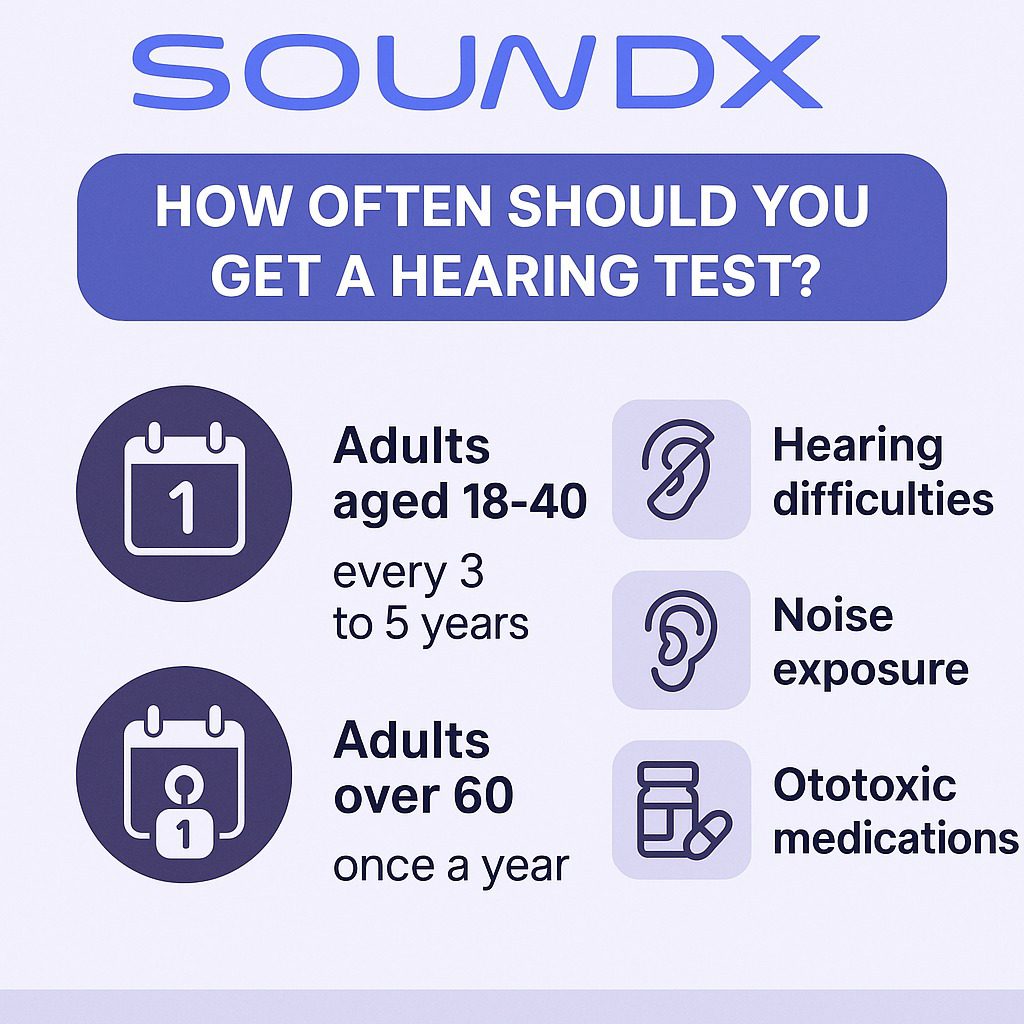
Hearing Test Frequency Guidelines
Recommended testing schedules based on age and risk factors
| Age Group / Category | Recommended Frequency | Why It Matters | Additional Notes |
| Healthy Adults (Under 50) | Every 3-5 years | Establish baseline hearing levels and catch early changes | More frequently if symptoms appear |
| Adults Over 50 | Annually | Age-related hearing loss accelerates after 50 | Critical for maintaining quality of life |
| Children (School Age) | At least once during school years | Early detection supports learning and communication development | Teachers may notice signs first |
| Workers in Noisy Environments | Annually | Exposure to 85+ dB can cause permanent damage over time | Includes factory workers, construction, traffic-heavy areas |
| Musicians & Audio Professionals | Annually | Regular exposure to loud music increases risk | Hearing protection essential |
| People with Tinnitus | Immediately, then as advised | Tinnitus may signal underlying hearing damage | Can be early warning sign |
| If Noticing Symptoms | Immediately | Early intervention prevents further deterioration | Don’t wait for scheduled test |
| Existing Hearing Aid Users | Annually or as advised | Monitor progression and adjust treatment | Device settings may need updating |
Bottom Line
You should get your hearing tested every few years, and sooner if you notice any difficulty.
It’s a small step that protects one of your most important senses — your ability to connect, listen, and communicate clearly.
If you haven’t had your hearing checked recently, visit Soundx – your trusted hearing aid center in Lucknow for a free hearing test and expert guidance.
FAQs
1. How long does a hearing test take?
A standard hearing test usually takes 15–30 minutes and is completely painless.
2. Is a hearing test only for older people?
No, anyone — even children — can get a hearing test. Hearing loss can happen at any age.
3. Will the test show if I need a hearing aid?
Yes, your audiogram results will show the level of your hearing loss and whether a hearing aid can help.
4. How do I prepare for a hearing test?
You don’t need special preparation. Just make sure your ears are clean and free from wax buildup.
5. Can I take an online hearing test?
Yes, online hearing tests can give you a quick idea, but they don’t replace a full test with an audiologist.
6. How much does a hearing test cost?
Many hearing centers offer free or low-cost hearing tests, depending on your location.
7. Can hearing loss improve by itself?
In some temporary cases (like earwax blockage or infection), it can improve — but most permanent hearing loss needs professional care.
8. Where should I go for a hearing test?
Visit a licensed hearing aid center or audiologist like Dr. S. M. Tarique at your nearest hearing care clinic.