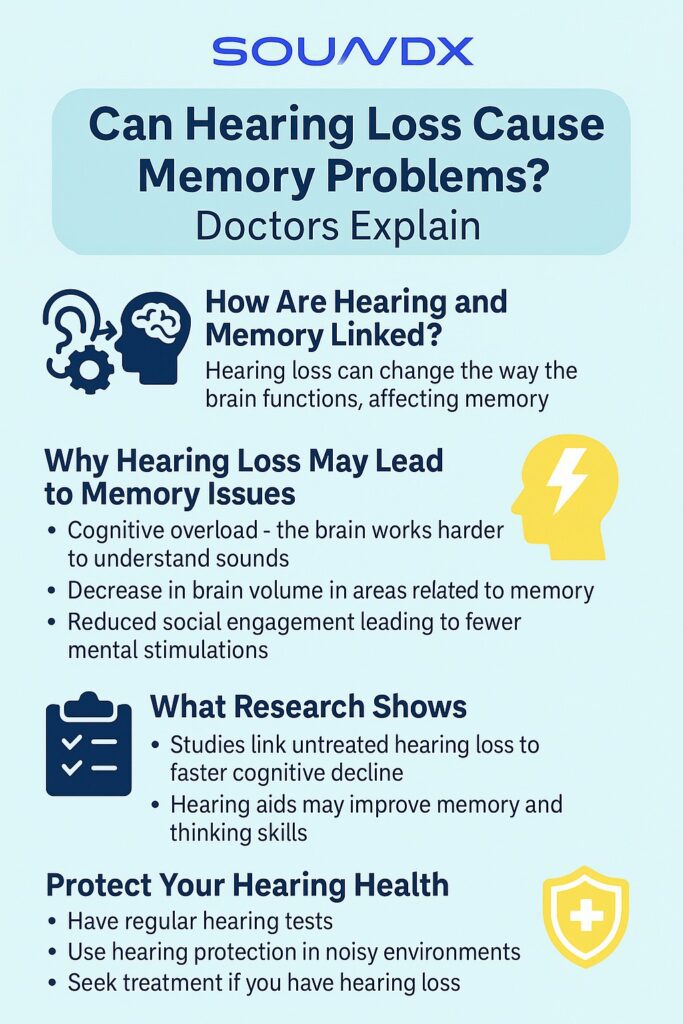
Can Hearing Loss Cause Memory Problems? Doctors Explain

Written by- Dr. S.M. Tarique Najeeb

Untreated hearing loss can raise your risk of dementia—mild loss doubles the risk, moderate loss triples it, and severe loss increases it fivefold. Even a small 10-decibel drop in hearing raises dementia risk by 16%. Studies show nearly 1 in 3 adults over 65 have some hearing loss, yet only 1 in 5 use hearing aids. The good news: using hearing aids can lower dementia risk, improve memory, and help you stay socially connected. Protecting your hearing isn’t just about listening—it’s about keeping your brain healthy.

Your hearing can reveal what’s happening inside your body. Your ears hear more than sound; they reflect your body’s overall health.

How Your Ears and Brain Work Together to Shape Your Hearing

To understand how hearing loss affects your memory, you first need to know how closely your ears and brain work together.

Hearing is not just about your ears picking up sounds. Your brain also plays a big role. When you hear something, your ears send signals to your brain. Then, different parts of your brain work like a team to understand the sound, remember it, and make sense of it.

So, when your hearing doesn’t work well, your brain has to work harder, and that can sometimes make your memory weaker.

The Amazing Journey of Sound: From Your Ears to Your Brain Explained

When sound enters your ears, it doesn’t just stop there. It travels through special sound pathways and reaches a part of your brain called the auditory cortex (that’s in your temporal lobe). This is the place where your brain first starts to make sense of the sounds.

But the journey doesn’t end there. The sound signals then move to other brain areas that handle things like:

  • Memory (to help you remember what you heard)
  • Attention (to help you focus on the sound)
  • Thinking and decision-making (to help you respond the right way)

All these parts of the brain work together so you can understand speech, follow conversations, and reply properly.

Here’s the cool part: the same brain areas that process sound also help with memory and thinking skills. That’s why, if someone has hearing problems, it can also affect their memory and other mental abilities at the same time.

So How Exactly Does Hearing Loss Impact Your Memory?

Scientists have identified several key ways that hearing loss directly impacts memory and cognitive function. And honestly, some of this research is pretty eye-opening.

Ever Feel Mentally Exhausted After Trying to Follow a Conversation?

There’s something called the Cognitive Load Theory, and it provides perhaps the most compelling explanation for the hearing-memory connection.

When you have hearing loss, your brain has to work significantly harder to process unclear or distorted sounds. Think of it like this: instead of your brain running smoothly in normal mode, it’s constantly working in overdrive just to figure out what people are saying.

This increased effort diverts precious mental resources away from other essential functions – like encoding memories and recalling information.

Here’s some fascinating research: Dr. Jonathan Peale used functional MRI scans and found that people with mild to moderate hearing loss show reduced activation in their primary auditory cortex but increased activity in their prefrontal cortex. These are areas that typically aren’t needed for sound processing.

Essentially, your brain is borrowing cognitive resources from memory and executive function areas to help process sound. This leaves fewer resources available for actually remembering information.
The Hearing Loss-Memory Connection: A Complete Overview

AspectDetails
How Ears & Brain Work TogetherSound travels through auditory pathways to the temporal lobe, then distributed to areas responsible for working memory, attention, and executive function
Cognitive Load TheoryBrain works overtime to process unclear sounds, diverting cognitive resources from memory encoding and recall tasks
Brain Activity ChangesReduced activation in auditory cortex, increased activity in prefrontal cortex (borrowing resources from memory areas to understand sound)
Social ImpactCommunication becomes exhausting, leading to social isolation, depression, and accelerated cognitive decline
Brain Structure ChangesAccelerated shrinkage in temporal gyrus areas responsible for sound processing, speech comprehension, and memory functions due to lack of auditory stimulation
Short-Term Memory EffectsForgetting conversations immediately after they happen, missing important details, losing track of instructions, struggling to follow discussions in noisy environments
Long-Term Memory EffectsIncreased risk of Mild Cognitive Impairment (MCI), higher dementia rates, and accelerated cognitive aging over time
Dementia Risk (Mild Hearing Loss)2x higher risk of developing dementia compared to people with normal hearing
Dementia Risk (Moderate Hearing Loss)3x higher risk of developing dementia compared to people with normal hearing
Dementia Risk (Severe Hearing Loss)5x higher risk of developing dementia compared to people with normal hearing
Hearing Aids ImpactUsing hearing aids leads to 19% decrease in cognitive decline risk, 14% improvement in working memory performance, and 20% improvement in attention and focus
Protection StrategiesRegular hearing checkups after age 50, early hearing aid adoption when needed, engaging in cognitive activities (reading, puzzles), maintaining healthy lifestyle including exercise and social connections (can reduce dementia risk by 37%)

Why Do People with Hearing Loss Often Become More Isolated?

Social withdrawal is another critical pathway linking hearing loss to memory problems. And this one creates a really vicious cycle.

When communication becomes effortful and exhausting, many people with hearing loss begin avoiding social situations. This leads to isolation and depression, which research shows accelerates cognitive decline.

The numbers are concerning: studies demonstrate a strong relationship between depression and hearing loss among U.S. adults of all ages. Adults with untreated hearing loss are significantly less likely to participate in organized social activities.

Social isolation has been directly linked to faster cognitive decline and increased dementia risk. So you end up with this cycle where hearing loss leads to isolation, which further accelerates memory problems.

Can Hearing Loss Actually Change Your Brain Structure?

This might be the most alarming finding of all: there’s evidence showing that hearing loss physically changes your brain structure.

Research from Johns Hopkins Medicine found that individuals with untreated hearing loss experience accelerated brain shrinkage – particularly in areas crucial for memory and cognitive function.

Here are the specifics: people with hearing loss had faster rates of brain shrinkage in the superior, middle, and inferior temporal gyrus structures. These areas process sound and speech but are also heavily involved in memory and sensory integration.

This shrinkage occurs because these brain regions receive less stimulation due to impaired hearing. It’s basically the “use it or lose it” principle at work in your brain.

What Does the Research Actually Show? (The Numbers Are Pretty Striking)

The scientific evidence connecting hearing loss to memory problems is honestly overwhelming.

Dr. Frank Lin’s Landmark Study

Dr. Frank Lin followed 639 adults for nearly 12 years, and here’s what he found:

  • Mild untreated hearing loss: doubled dementia risk
  • Moderate loss: tripled the risk
  • Severe hearing loss: made people five times more likely to develop dementia

Recent Large-Scale Research Confirms These Findings

A comprehensive 2024 study in Denmark involving 573,088 participants confirmed these findings. The study showed that hearing loss was associated with increased dementia risk, with severe hearing loss carrying a 20% higher risk.

But here’s the really important part: the study also revealed crucial evidence about treatment:

  • People with hearing loss who didn’t use hearing aids had a 20% higher dementia risk
  • Those using hearing aids had only a 6% increased risk

That’s a huge difference that shows treatment really matters.

The Molecular Level Evidence

Recent research published in Nature Aging even identified specific molecular mechanisms. The study showed how hearing loss reduces levels of something called GDF1 protein, leading to greater amyloid-β plaque deposits – which is a signature pathology of Alzheimer’s disease.

What Are the Immediate Memory Problems You Might Notice?

When someone has hearing loss, memory problems often show up early. Many people don’t realize these issues are connected to their hearing.

Some common signs are:

  • Forgetting what someone just said
  • Missing important details in a conversation
  • Getting confused when following step-by-step instructions
  • Having trouble keeping up in group talks, especially if it’s noisy
  • Only remembering part of what was said in social situations

Why does this happen? Because when your ears don’t hear clearly, your brain has to work extra hard just to understand the words. Since your brain is so busy trying to “decode” the sounds, it doesn’t have enough energy left to store those words in memory.

That’s why sometimes you hear someone speak but can’t remember it a few minutes later.

What Happens to Your Memory in the Long Term?

If hearing loss is not treated, it can cause bigger problems for your memory over time.

Research shows that untreated hearing loss can increase the risk of:

  • Mild memory problems (called Mild Cognitive Impairment or MCI)
  • Different types of dementia (when the brain has trouble thinking and remembering)
  • Faster aging of the brain (your memory and thinking skills can get weaker sooner than normal)

So, hearing problems don’t just make it hard to hear today—they can affect your brain and memory years down the road.

A Concerning Study from China

A comprehensive study of older adults in China found that participants with hearing loss plus unhealthy lifestyle factors had approximately a twofold increased risk of cognitive impairment.

Even more concerning: the brain structural changes associated with hearing loss are comparable to those seen in people developing mild cognitive impairment.

The Timeline Matters

Here’s something critical to understand: hearing loss doesn’t just increase immediate memory problems. It sets in motion a cascade of brain changes that accelerate cognitive aging and increase dementia risk over years or decades.

That’s why early intervention is so important – the sooner you address hearing loss, the more you can potentially prevent or slow down these long-term changes.

Can Hearing Aids Actually Improve Your Memory? (The Answer Might Surprise You)

Here’s the really encouraging news: treating hearing loss can significantly improve memory and cognitive function. And the research backing this up is pretty impressive.

The Numbers Show Real Improvement

A groundbreaking analysis of 31 studies involving 137,484 participants found that hearing aid use was associated with:

  • A 19% decrease in long-term cognitive decline risk
  • A 3% improvement in short-term cognitive test scores

Dr. Jamie Desjardins’ Remarkable Research

Dr. Desjardins showed some pretty amazing improvements in hearing aid users after just six months:

  • Working memory improved by 14%
  • Selective attention improved by 20%
  • Processing speed increased significantly

Another study found that after 18 months of hearing aid use, participants showed significant improvement in executive function and had no cognitive decline.

Why Do Hearing Aids Help Memory?

The mechanism is actually pretty clear: by restoring auditory input, hearing aids reduce the cognitive load on your brain. This allows your brain to redirect resources back to memory and other cognitive functions.

This explains why early intervention is so crucial – the sooner hearing loss is treated, the more cognitive resources can be preserved.

How Can You Protect Both Your Hearing and Your Memory?

Protecting your hearing health is honestly one of the most effective ways to preserve memory and cognitive function as you age.

Regular Checkups Are Your First Line of Defense

Regular hearing checkups should be part of your routine health maintenance, especially after age 50. Early detection allows for prompt intervention before significant cognitive impacts occur.

Remember: the earlier hearing loss is found, the sooner you can get the services and treatment you need to support your overall brain health.

Don’t Wait to Get Hearing Aids

Early hearing aid adoption is crucial. Research shows the protective effects are strongest when treatment begins early.

Don’t wait until hearing loss severely impacts your daily life – even mild hearing loss can benefit from intervention. The Denmark study we mentioned earlier proves this point perfectly.

Keep Your Brain Active and Engaged

Mental exercises and cognitive training can provide additional protection beyond hearing aids:

Try these brain-boosting activities:

  • Auditory training exercises
  • Brain games and puzzles
  • Staying socially engaged
  • Listening to music
  • Engaging in complex conversations
  • Learning new skills

All of these provide valuable brain stimulation and help maintain cognitive resilience.

Healthy Lifestyle Habits Make a Big Difference

When combined with hearing care, healthy lifestyle habits significantly reduce your risk:

Focus on these areas:

  • Follow a Mediterranean diet rich in antioxidants
  • Get regular physical activity
  • Don’t smoke
  • Limit alcohol consumption

Research shows that sticking to healthy lifestyle factors can reduce cognitive impairment risk by 37% – even in people who already have hearing loss.

The Bottom Line: Healthy Ears Keep Your Brain Healthy

Taking care of your hearing is also taking care of your brain and memory. Hearing loss isn’t just about missing sounds—it can also make it harder to think clearly, remember things, and stay independent as you get older.

The good news is that this works both ways. Just like hearing problems can make memory worse, treating hearing loss can help your brain work better and lower the risk of dementia.

The most important thing is to find and treat hearing problems early before they cause permanent changes in your brain.

Don’t Wait Until It’s Too Late

Don’t wait for your hearing to get worse or for memory problems to become noticeable. Schedule a full hearing checkup at MySoundX today.

Getting your hearing checked could be one of the most important steps to protect your memory, thinking skills, and overall brain health for years to come.

Remember: when you take care of your hearing, you’re also taking care of your brain. That’s a strong reason to act now!

FAQs – Hearing Loss and Memory

  1. Can hearing loss affect my memory?
    Yes! When your ears don’t hear clearly, your brain works harder, leaving less energy to remember things.
  2. Why do I forget conversations if I have hearing problems?
    Your brain spends most of its energy trying to understand sounds, so it doesn’t store the information in memory properly.
  3. Does hearing loss cause long-term brain problems?
    Untreated hearing loss can increase the risk of memory problems, mild cognitive issues, and even dementia over time.
  4. Can hearing aids help my memory?
    Yes! Using hearing aids reduces the brain’s workload and helps improve memory, attention, and thinking skills.
  5. Why do people with hearing loss feel isolated?
    Hearing problems make conversations tiring, so some people avoid social situations, which can hurt memory and mental health.
  6. Does hearing loss change the brain?
    Yes, untreated hearing loss can shrink parts of the brain involved in hearing, memory, and thinking.
  7. When should I get my hearing checked?
    It’s best to get a hearing check regularly, especially after age 50, or as soon as you notice hearing problems.
  8. How can I protect my brain and hearing?
    Use hearing aids if needed, stay socially active, do brain exercises, eat healthy, exercise, and avoid smoking or too much alcohol.

Dr. S.M. Tarique Najeeb Audiologist says:

“SoundX proudly participates in ISHACON 2025, Patna, Bihar — one of India’s largest and most respected audiology conferences!”

Visit Profile- Dr. S.M. Tarique Najeeb
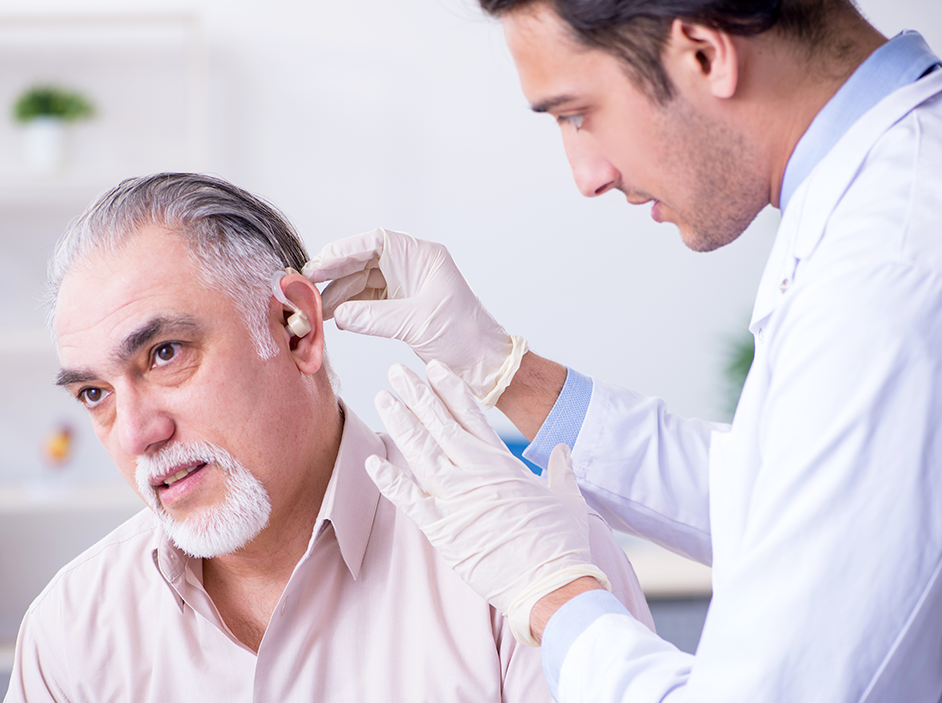
Stress-Free Travel Tips for People With Hearing Loss

Written by- Dr. S.M. Tarique Najeeb

Plan Stress-Free Trips and Travel Confidently With Hearing Loss 

Did you know that over 466 million people worldwide live with hearing loss, and millions of them travel successfully every year? In fact, research shows that travelers who use hearing aids or assistive devices report 40% higher satisfaction on their trips. While it’s natural to worry about missing flight announcements, struggling to communicate abroad, or feeling unsafe in new places, the truth is simple—with the right preparation, hearing loss doesn’t have to limit your adventures at all. With some smart tips and planning, anyone can explore the world confidently and enjoy every moment.

“At our recent hospital event, SoundX took hearing health awareness to new heights — empowering more people to listen, care, and act for better hearing.”

Why Does Planning Ahead Make Such a Huge Difference?

To understand how to travel successfully with hearing loss, you first need to know that preparation really is your greatest travel companion. And when I say preparation, I mean getting specific about what you need.

Hotel Booking Tips for People With Hearing Loss

When picking a hotel, don’t just book the first one you see. Ask about special features for people with hearing loss, because many hotels now offer helpful kits for guests.

These kits often include:

  • Phones that are louder than normal
  • Alarm clocks that vibrate
  • Fire alarms with flashing lights
  • Doorbells that flash when someone rings

Here’s an important tip: Hotels must provide accessible rooms under the law (Americans with Disabilities Act). So don’t be shy—ask for these special features when you book. It’s your right!

How Can Airlines Actually Help You Travel Better?

For air travel, you should familiarize yourself with the Air Carrier Access Act (ACAA) because it requires carriers to provide accessible information and services.

Most major airlines now offer:

  • Text telephone services
  • Visual boarding announcements
  • Individual safety briefings upon request

Pro tip: Contact airlines at least 48 hours before travel to inform them of your needs and request assistance. This simple step can prevent so many headaches later.

Also, research your destination’s accessibility features ahead of time. Many airports now have hearing loop systems that can connect directly to hearing aids with telecoil programs, and tourist attractions increasingly offer assistive listening devices.

Cool Technology Tricks to Make Traveling Easier for People With Hearing Loss

Modern technology offers some pretty powerful tools to improve your travel experience. And honestly, some of these advances are game-changers for people with hearing loss.

Hearing Aid Apps – Many hearing aids connect to smartphones. You can adjust volume, change settings, or get alerts directly on your phone.

Captioning Apps – Some apps show live captions for conversations or announcements, so you can read what’s being said in real-time.

Alert Devices – Smart watches or phone alerts can vibrate or flash when there’s a loud sound like a train whistle, alarm, or announcement.

Translation & Travel Apps – Apps can translate signs or announcements into text, helping you understand travel instructions without missing anything.

GPS & Navigation Tools – Smart maps with notifications can guide you through airports, stations, or streets, so you don’t miss your way.

Noise-Cancelling Headphones – These help focus on important sounds and reduce background noise, making it easier to hear alerts or people speaking.

Do You Know How Amazing Modern Hearing Aids Are for Travel?

Here’s something cool: most modern hearing aids don’t require special “airplane mode” settings during flights. Bluetooth connectivity remains active even when your phone is in airplane mode, which means you can stream audio directly to your hearing aids.

Some hearing aids do offer flight mode options to disable wireless features if you prefer, but it’s usually not necessary.

Best Apps to Make Traveling With Hearing Loss Easy

Mobile apps can honestly be complete game-changers for travelers with hearing loss. Here are the ones that consistently get rave reviews:

For Communication:

  • AVA – provides real-time transcription of group conversations (perfect for tour groups)
  • Google Translate – offers real-time translation with visual text display
  • Live Transcribe – converts speech to text instantly

For Phone Calls:

  • CaptionCall Mobile – provides real-time phone call captions

For Environment Planning:

  • SoundPrint – measures noise levels in restaurants and venues, helping you choose quieter locations

Consider bringing assistive listening devices too like portable FM systems or personal amplifiers. These can be particularly helpful in noisy restaurants, tour buses, or conference settings.

Clear Communication Tips for Travelers With Hearing Loss

Clear communication strategies don’t just reduce stress – they actually improve your entire travel experience.

Use Visual Cues – Look for signs, symbols, or gestures to understand instructions in airports, trains, or hotels.

Text & Chat Apps – Use messaging apps to communicate with travel staff, guides, or friends instead of relying only on talking.

Write It Down – Carry a small notebook or use your phone to write questions or instructions when speaking is hard.

Speak Clearly & Ask for Repeats – Politely ask people to speak slowly, face you, or repeat if you don’t understand.

Use Translation Tools – If traveling abroad, apps can convert spoken words into text so you can read them instantly.

Share Your Needs – Let staff or travel companions know you have hearing loss so they can help you communicate better.

Should You Tell People About Your Hearing Loss?

Yes! Most people want to help, but they need to know the best way to communicate with you.

A smart tip: carry a small card that explains your hearing loss and how you like to communicate. This is especially helpful when traveling to other countries where language can be a barrier.

Where Should You Position Yourself for Better Communication?

In restaurants: Choose well-lit booths away from kitchens and speakers. The lighting helps with lip reading, and being away from noise sources makes a huge difference.

During tours: Stand where you can see the guide’s face clearly. Don’t be shy about moving to get a better position.

In meetings or conferences: Sit where you can see all speakers. Corner seats often work best because you can survey the whole room.

How Do Visual Cues Actually Help?

Use visual cues to enhance communication, and don’t feel awkward about it:

  • Look at people’s faces and make eye contact
  • Use hand gestures to show or explain things
  • Ask people to repeat if you didn’t hear clearly
  • Use translation apps that show text on screen when traveling

Air Travel Tips for People With Hearing Loss

Flying can be tricky if you have hearing loss, but airlines are getting better at helping passengers. Knowing a few tips can make your trip smoother and less stressful.

When Should You Inform Airline Staff?

Tell airline staff about your hearing loss:

  • When checking in
  • When boarding
  • Anytime you need help

Also, ask for written updates for gate changes, delays, or boarding announcements. Many airlines can send text alerts directly to your phone, which makes traveling much easier.

How Should You Handle Security Checkpoints?

At security checkpoints, follow these steps:

  • Inform TSA agents about your hearing aids beforehand
  • Never remove hearing aids or place them in bins (this can cause static damage)
  • Remember that hearing aids are exempt from electronic device restrictions

Pro tip: Request priority boarding if available because this gives you time to settle in and communicate with flight attendants about your needs. Ask for an aisle seat to facilitate communication with cabin crew too.

Many airports now display closed captions on all televisions and have visual flight information displays throughout terminals. Take advantage of airline apps for real-time updates as well.

How Can You Stay Safe While Driving to Your Destination?

If you’re driving, modern technology can help you stay safe, even with hearing loss. Many cars now have visual alerts, warning lights, and navigation prompts to keep you aware while on the road.

Best GPS Features to Make Your Journeys Smooth and Easy

Check out these helpful GPS features that make traveling easier for people with hearing loss:

Visual GPS Signals

  • GPS apps use clear visuals instead of sounds for people with hearing loss.

TomTom AmiGO App

  • Shows big arrows and speed warnings on-screen for easy navigation.

Smartwatch Alerts

  • Apps can send vibrations to watches like Apple Watch for turn-by-turn guidance.

Travel Benefits

  • Helps people with hearing loss travel safely and confidently.

How Should You Prepare for Emergencies?

Emergency preparedness is crucial:

  • Store emergency contact information in your phone with text-capable numbers
  • Consider carrying a visual warning light or beacon to alert first responders
  • Keep identification that mentions your hearing loss easily accessible

Interesting fact: Research shows that innovative systems are being developed to convert emergency vehicle sirens into visual dashboard alerts for hearing-impaired drivers, with some achieving 95% accuracy in sound recognition.

Travel Tools for Hearing Loss: A Quick Comparison

Travel AspectWithout PreparationWith Smart Planning
Hotel StayStandard room with basic featuresAccessible room with vibrating alarms, visual fire alerts, amplified phones
Air TravelMiss announcements, gate changes, delaysText alerts, visual boarding info, priority boarding assistance
CommunicationStruggle in noisy places, miss informationReal-time transcription apps (AVA, Live Transcribe), visual cues, written scripts
Group ToursDifficulty hearing guide, miss detailsBluetooth hearing loop systems, written itineraries, designated “hearing buddy”
Restaurant ExperienceNoisy environments, hard to hear conversationsSoundPrint app to find quiet venues, well-lit booths away from kitchen noise
Driving SafetyMiss audio GPS directions, emergency sirensVisual GPS alerts (TomTom AmiGO), smartwatch vibrations, dashboard visual warnings
Emergency SituationsDifficulty alerting first respondersMedical ID cards, text-capable emergency contacts, visual warning beacons
Overall SatisfactionLower travel satisfaction, more stress40% higher satisfaction with proper preparation and assistive devices

What Makes Group Travel and Tours Work Better?

Group tours can actually be particularly rewarding when you plan appropriately, and many tour companies are getting much better at accommodations.

What Should You Ask Tour Companies Before Booking?

Ask about accessibility accommodations before booking because many now offer:

  • Written scripts of tours
  • Captioning for videos
  • Guides equipped with microphone systems that work with hearing loops
  • Some companies even specialize in accessible tours and can provide sign language interpreters when needed

How Do Modern Tour Guide Systems Help?

Tour guide systems have evolved significantly. Many now offer Bluetooth connectivity or hearing loop compatibility that streams audio directly to hearing aids. These systems provide clear, amplified sound while reducing background noise.

Smart positioning strategies:

  • Stay close to the guide when possible
  • Don’t hesitate to ask questions if you miss information
  • Consider designating a “hearing buddy” who can help relay important information
  • Request written itineraries in advance so you can follow along even if you miss verbal announcements

What Should You Pack for Successful Travel?

A well-planned packing list ensures you’re prepared for any situation that comes up.

What Hearing Aid Essentials Should You Never Forget?

Pack these hearing aid essentials:

  • Extra batteries (pack twice what you think you’ll need – seriously)
  • Chargers for rechargeable hearing aids
  • International adapters if traveling abroad
  • Waterproof case and dehumidifier (especially for humid destinations)
  • Cleaning supplies: soft cloths, wax picks, and brushes

This helps travelers stay prepared and manage costs effectively.

Important: Carry a backup set of hearing aids if available, and store all hearing-related items in your carry-on luggage to avoid loss.

What Assistive Devices Should You Bring?

When you travel, it’s a good idea to bring your own assistive devices, such as:

  • Vibrating alarm clocks to wake you up
  • Phone amplifiers to hear calls better
  • Portable hearing loops for clearer sound

Many hotels don’t have these, so bringing your own helps you stay comfortable and independent.

Extra Tip: Pack a medical information card with your hearing loss details, other health info, and emergency contacts who can receive texts.

How Can You Actually Enjoy the Experience More?

Here’s something important to remember: hearing loss doesn’t define your travel experience – preparation and confidence do.

Research indicates that travelers with hearing loss who plan well often report higher satisfaction than those who don’t prepare. But beyond preparation, there’s something else that makes a huge difference.

Why People With Hearing Loss Might Have Travel Advantages

Embrace the visual aspects of travel because many travelers with hearing loss find they’re more attuned to:

  • Visual details others miss
  • Architectural features
  • Cultural nuances that hearing travelers overlook

Use this as an advantage to create rich, memorable experiences that are uniquely yours.

How Can You Connect with Local Communities?

Connect with local communities through visual means because art, food, and cultural activities often transcend language barriers completely.

Many destinations now offer:

  • Visual tours
  • Interactive exhibits
  • Hands-on cultural experiences specifically designed for accessibility

Pro tip: Document your journey through photography and journaling. These visual memories can be just as meaningful as auditory ones, and sharing your travel experiences can inspire other people with hearing loss to explore the world confidently.

The Bottom Line: Your Next Adventure Awaits

Traveling with hearing loss is possible and can be fun and rewarding when you plan ahead. Using best hearing aids, helpful apps, and assistive devices makes trips easier and safer.

Millions of people with hearing loss travel successfully every year. The key is preparation, confidence, and self-advocacy.

Enjoy Your Travel With Expert Support

Before your next trip, consider scheduling hearing tests to ensure your devices are functioning optimally., check in with MySoundX. They can ensure your hearing aids are travel-ready, suggest useful devices, and give personalized tips.
This is also a good opportunity to schedule 🟢 hearing tests to make sure everything is working perfectly.

With the right support, you’re ready to explore the world and make lasting memories!

FAQ

1. Can people with hearing loss travel safely?
Yes! With hearing aids, apps, and smart planning, people with hearing loss can travel safely and enjoyably.

2. How can hotels help travelers with hearing loss?
Many hotels provide flashing alarms, loud phones, and vibrating clocks. Always ask for these when booking.

3. What should I tell airlines before flying?
Inform them about your hearing loss, request text updates for gates or delays, and ask for any needed help during the flight.

4. Are there apps that help with hearing while traveling?
Yes! Apps like AVA, Live Transcribe, and CaptionCall show speech as text, translate languages, or caption phone calls.

5. How can I hear better in noisy places?
Use assistive devices, sit near speakers, pick quiet spots in restaurants, and look at people’s faces for lip reading.

6. Do hearing aids work well on airplanes?
Yes! Most modern hearing aids work fine on planes, and some can even connect to phones or Bluetooth devices.

7. Can hearing loss give any travel advantages?
Yes! People with hearing loss often notice visual details, cultural cues, and experiences others might miss.

8. What should I pack for traveling with hearing loss?
Extra batteries, chargers, waterproof cases, cleaning tools, backup hearing aids, and a medical info card.

Dr. S.M. Tarique Najeeb Audiologist says:

Hearing loss is easier to fix when you catch it early. Most people wait too long and make it harder to recover clarity.

Visit Profile- Dr. S.M. Tarique Najeeb
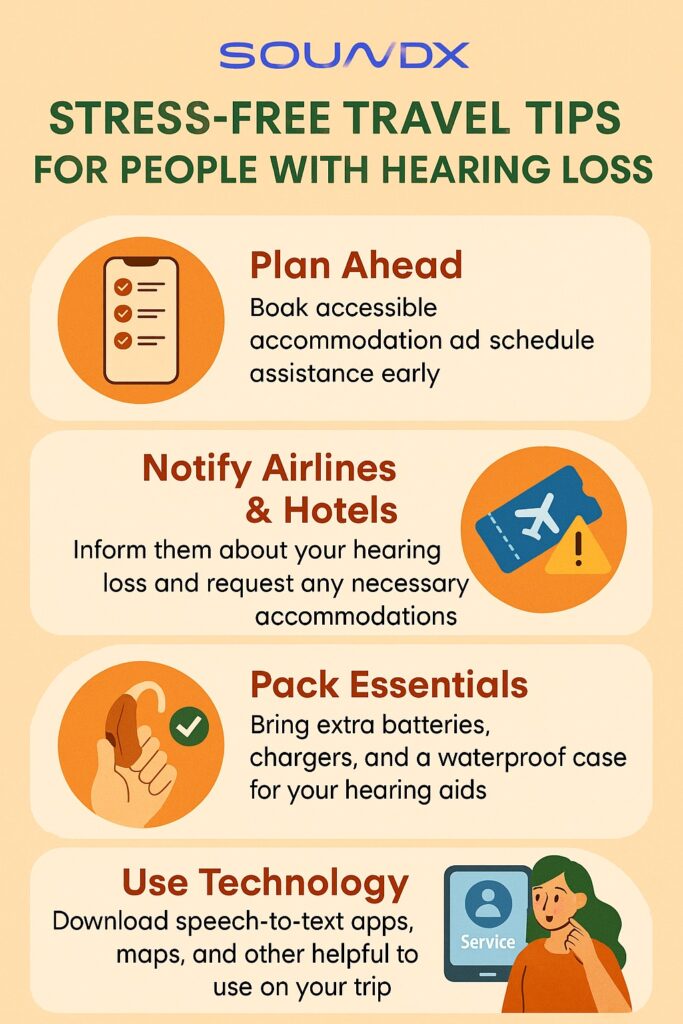
What are the best hearing aids in Lucknow?

Written by- Founder Vinod Kumar

Welcome to your place for best hearing aids in Lucknow. We understand how important good hearing is for daily life. In India, around 63 million people have some level of hearing loss — that’s about 6.3% of the population. Among them, 7.6% of adults and 2% of children are affected, making the need for the right hearing aid more important than ever.

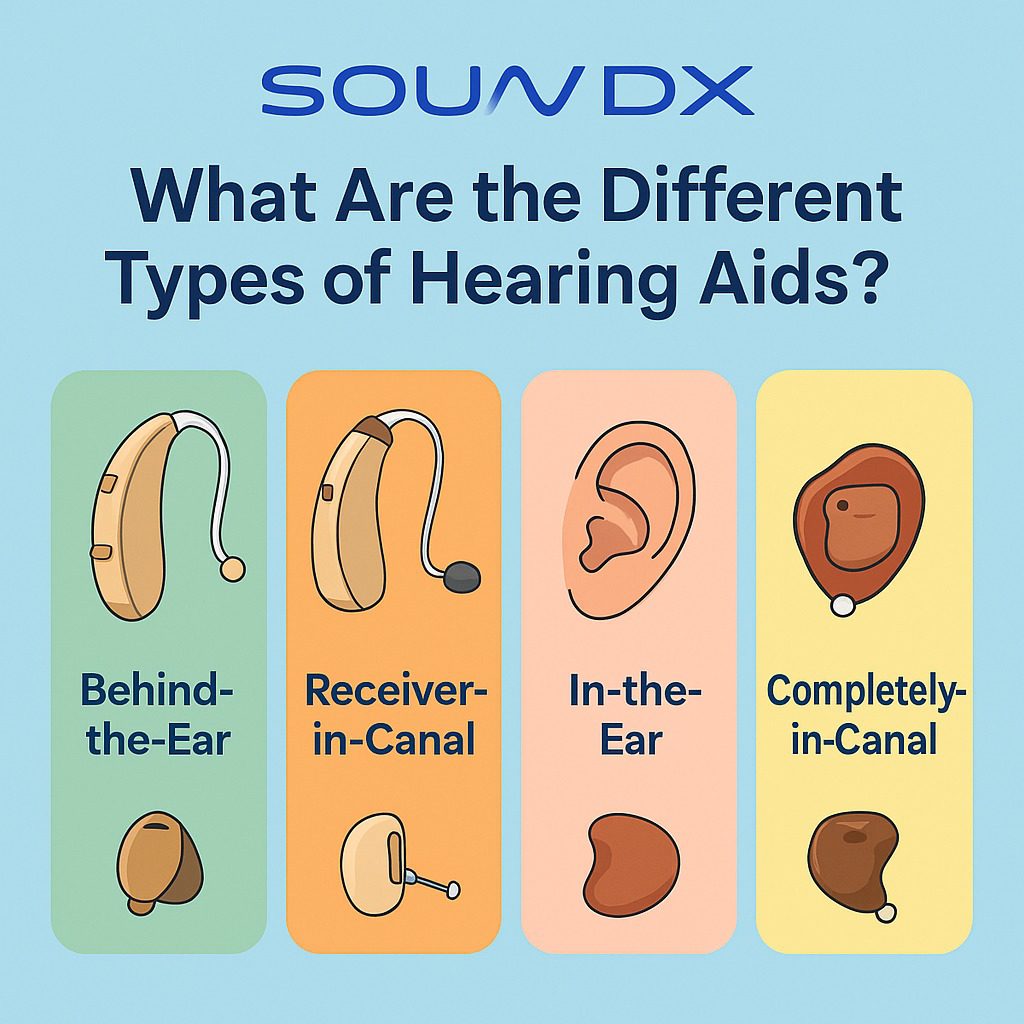
At SoundX, we offer high-quality hearing aids designed with modern technology to provide clear and natural sound. Whether your hearing loss is mild, moderate, or severe, we have the perfect device for you. Our comfortable styles, like behind-the-ear (BTE) and receiver-in-canal (RIC) models, are made for all-day comfort and better clarity. Whether you’re getting a hearing aid for the first time or planning to upgrade, SoundX helps you find the perfect fit and reconnect with the beautiful world of sound.

SoundX visited an old age home to bring the gift of hearing to seniors, helping them reconnect with their loved ones and the world around them.”

Schedule a consultation to pair your new device with a proper hearing test for best results.

Please find our products here.

Why SoundX Hearing Solutions Are Trusted by Families Across Lucknow

SoundX hearing aids are made to be comfortable, work really well, and fit your unique needs. Our hearing aids are small and stylish – much smaller than the big, bulky hearing devices you might have seen before. Think of them as tiny helpers that sit discreetly behind your ear, so most people won’t even notice you’re wearing them.

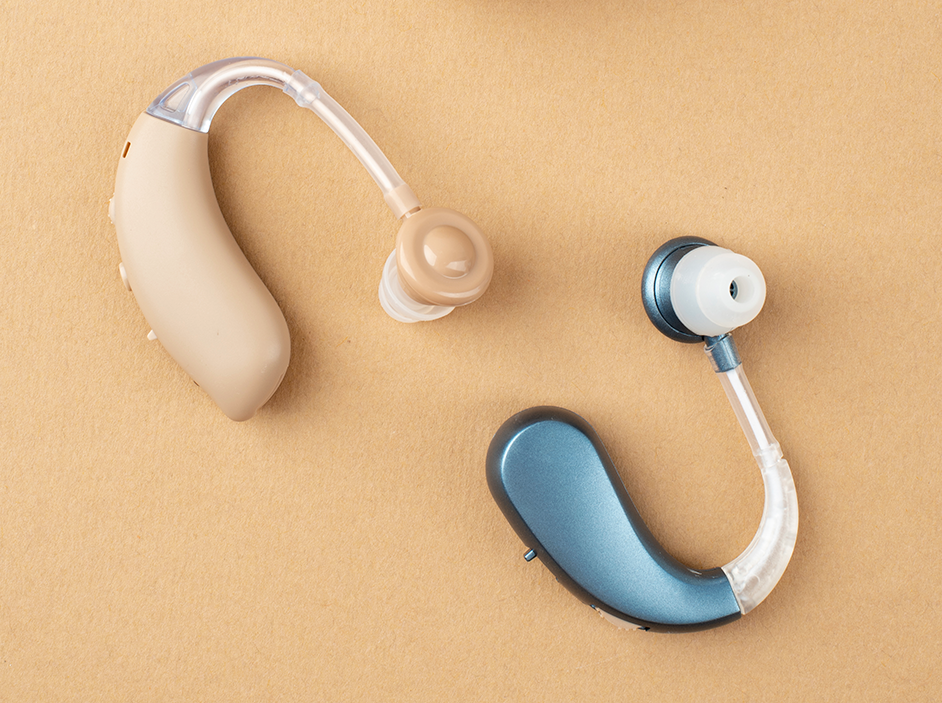
We offer three amazing options to match different hearing needs. SoundX Flow and SoundX Wave feature a compact design that fits behind your ear (called RIC design) and are perfect for people with severe hearing loss (when it’s very hard to hear). These models are comfortable to wear all day and blend in naturally. If you have moderate hearing loss (when it’s somewhat hard to hear), then SoundX Pulse is your best choice. This super tiny behind-the-ear device is specially designed for everyday conversations with friends and family.

Features That Make Life Easier

All SoundX hearing aids make hearing effortless. They reduce background noise so you can focus on what matters — from classroom lessons to friendly chats. With Bluetooth connectivity, you can listen to music, take calls hands-free, and watch videos with clear sound.

The battery lasts up to 18 hours on a single charge, and the SoundX app automatically adjusts settings to your hearing needs. Our devices are waterproof, dustproof, and built for everyday use. Plus, you get expert support, a 15-day money-back guarantee, and a 2-year replacement warranty — so you can hear the world with confidence.

Changes made:

  • Reduced to just 2 main subheadings
  • Combined information into flowing paragraphs
  • Kept the simple, kid-friendly language
  • Maintained explanations of technical terms
  • Made it conversational and easy to read

Compare SoundX Hearing Aids and Choose the Model That Suits You Best

  FeatureSoundX FlowSoundX WaveSoundX Pulse
Design TypeReceiver-in-Canal (RIC)Receiver-in-Canal (RIC)Mini Behind-the-Ear (BTE)
Best ForSevere hearing lossSevere hearing lossModerate hearing loss
SizeCompact and discreetCompact and discreetSuper tiny and miniaturized
Ideal UseAll-day comfort for severe hearing issuesAll-day comfort for severe hearing issuesEveryday conversations
Noise Cancellation✓ Advanced✓ Advanced✓ Advanced
Bluetooth Streaming✓ Yes (Calls, Music, Videos)✓ Yes (Calls, Music, Videos)✓ Yes (Calls, Music, Videos)
Battery LifeUp to 18 hoursUp to 18 hoursUp to 18 hours
Rechargeable✓ Yes✓ Yes✓ Yes
SoundX App Control✓ AI-powered personalization✓ AI-powered personalization✓ AI-powered personalization
Waterproof✓ Yes✓ Yes✓ Yes
Dustproof✓ Yes✓ Yes✓ Yes
Warranty2 years with replacement2 years with replacement2 years with replacement
Money-Back Guarantee15 days15 days15 days
Professional Support✓ Included✓ Included✓ Included

Get the Best Hearing Aid Machine at Low Prices Today

Looking for a hearing aid that works well but doesn’t cost too much? SoundX makes it easy! We offer affordable hearing aids that help you hear clearly without spending too much. Our prices are some of the best in India.

At SoundX, we don’t just sell hearing aids—we help you choose the right one. Our experts guide you step by step so you can find the hearing aid that fits you perfectly.

Come to SoundX and hear the difference! Clear hearing can make life more enjoyable. Contact us today for a free consultation and find the hearing aid that’s right for you.

FAQ

  • How long will my SoundX hearing aids last?
    SoundX hearing aids usually last five to seven years, depending on how you use and care for them, and regular check-ups help keep them working well.
  • Can I wear my hearing aids while sleeping?
    It’s better to take them out while sleeping to keep your ears comfortable and give them a rest.
  • How do I clean and take care of my hearing aids?
    You should gently wipe your hearing aids with a soft, dry cloth and make sure the microphone and small parts are free of dust, and you can check your user guide for more details.
  • What should I do if my hearing aids aren’t working properly?
    If you hear distorted sound or no sound, first check the battery and make sure the device is clean, and if it still doesn’t work, you can contact SoundX support at support@mysoundx.com.
  • Can I use my hearing aids while exercising?
    SoundX hearing aids are strong, but it’s best to remove them during intense sports or high-impact activities to avoid damage.
  • Do SoundX hearing aids come with a remote control?
    Yes, you can use the SoundX app on your smartphone to adjust settings and control your hearing aids easily.
  • How do I know if my hearing aids need repair?
    You might need a repair if the sound is lower than usual, cuts in and out, or stops completely, but make sure your device is clean and the battery works before seeking repair.
  • Can I buy replacement parts for my hearing aids?
    Yes, you can buy batteries, ear molds, and filters from the SoundX website or by contacting customer support.

Founder Vinod Kumar Audiologist says:

Step away from the cotton buds! Most ear-cleaning mistakes do more harm than good.

How Does a Hearing Test Work? Expert Audiologist Explains the Process

Written by- Dr. S.M. Tarique Najeeb

A hearing test checks if your ears are working properly and doesn’t always mean something is wrong. Experts say adults should test their hearing every 10 years until age 50 and every 3 years after that. Around 15% of adults worldwide have some degree of hearing loss, and many of them don’t even know it. Early detection can help prevent further hearing problems and improve your quality of life. Regular tests also help doctors recommend the right treatment or hearing aid if needed.

What Happens During a Hearing Test?

A hearing test is done by a doctor called an audiologist. This test checks how well you can hear different sounds and pitches. It can also show if hearing aids could help you hear better.

It can also show if hearing aids could help you hear better. Once your device is optimized, using travel-ready hearing aids can make trips safer and more enjoyable.

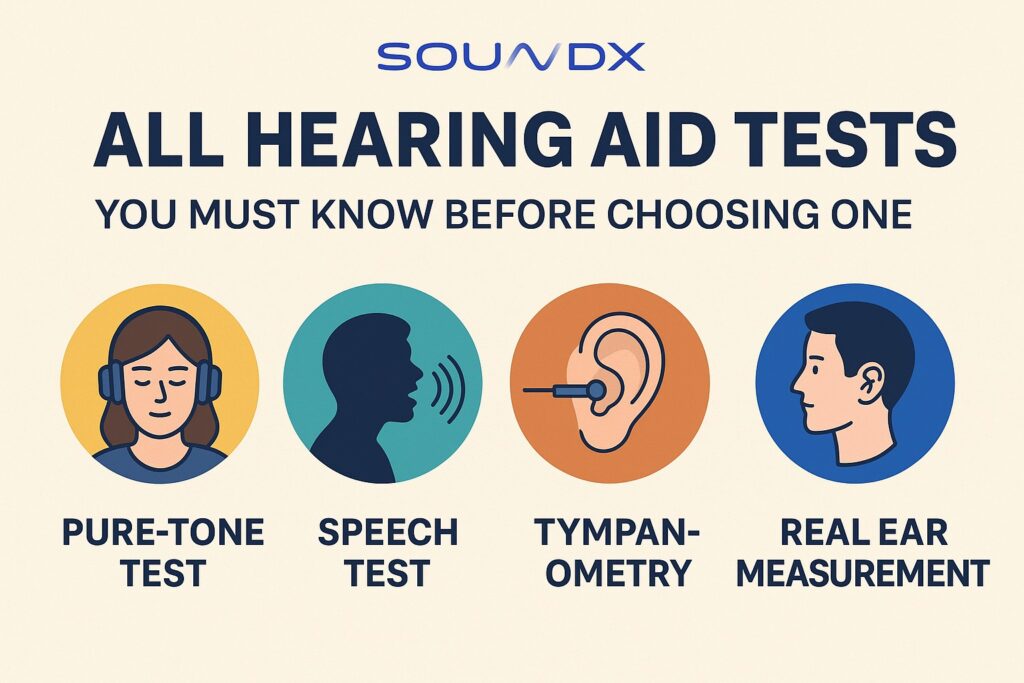
There are different types of hearing tests, such as:

  • Pure-tone audiometry – tests your ability to hear simple tones.
  • Speech audiometry – checks how well you can hear and understand speech.
  • Bone conduction testing – finds out if your inner ear works properly.
  • Acoustic reflex testing – checks how your ears react to loud sounds.
  • Tympanometry – measures how your eardrum moves.

The audiologist will choose the test depending on your age and other factors.

Hearing loss can happen slowly, so sometimes you don’t notice it. Adults with untreated hearing loss may start avoiding social events because it’s hard to hear conversations. That’s why it’s important to get tested when your doctor suggests it.

A hearing test helps find out:

  • If you have hearing loss.
  • How mild or severe it is.
  • What type of hearing loss it is—conductive, sensorineural, or mixed.
  • Whether you need treatment, hearing aids, bone-anchored hearing systems, or cochlear implants.

Hearing tests are painless and usually take about 30 minutes. They are done in a quiet room that blocks outside noises. You’ll wear earphones, one ear at a time, and listen to short tones played at different volumes and pitches. A machine called an audiometer checks if you can hear each sound clearly and whether one ear hears better than the other.

Hearing test RESULTS

You do not pass or fail this exam. However, the results determine whether you have a hearing loss in one or both ears and the percentage of hearing loss.

You can measure sound in two ways- decibels (dB) and hertz (Hz). It measures volume or level in decibels (dB), whereas it measures pitch or frequency in hertz (Hz).

You are most likely to hear these terms from your audiologist when they explain your test results to you. 

Here’s the breakdown 

Mild hearing loss26 to 40 decibels
Moderate hearing loss41 to 55 decibels
Moderate-to-severe hearing loss56 to 70 decibels
Severe hearing loss71 to 90 decibels
Profound hearing loss91 to 120 decibels

Understanding your results

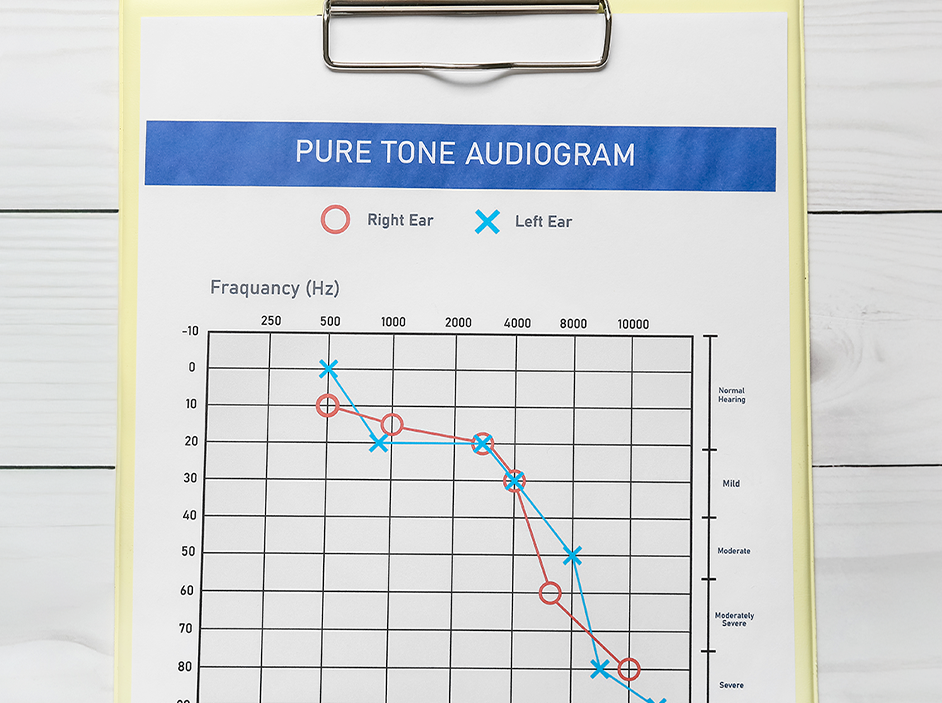
Your audiologist will hand you a graph called an audiogram demonstrating the intensity of sounds you can hear at different pitches or frequencies. The vertical axis denotes the volume of the sounds, whereas the horizontal axis depicts the frequency or pitch of the sound.

What is an Audiogram?

The audiogram outlines your hearing thresholds across various volumes and pitches in a silent room. You will hear a few soft tones that you can detect half of the time. However, it’s absolutely fine if you missed some. More importantly, an audiogram uses a numerical system to measure hearing ability; therefore, it is quantitative, not qualitative. It will not describe the quality of your hearing ability and may not detect if you have hidden hearing loss. 

How does an audiogram look?

The graph here represents a blank audiogram with the degrees of hearing loss. Frequency is the top part of the graph, ranging from 125 Hz on the left to 3000 Hz (sometimes till 8000 Hz) on the right. Sound hearing level is outlined on the left side of the graph ranging from -10 dB at the top to 120 dB at the bottom.

How to read and understand audiograms?

Understanding an Audiogram

Reading an audiogram is easier than it sounds. The Y-axis shows how loud a sound is in decibels (dB), from -10 to 120. The X-axis shows the pitch of the sound in hertz (Hz), from 125 to 8,000.

Even though the Y-axis starts at -10 dB, it doesn’t mean there is no sound. It just shows the softest sound a person with normal hearing can hear at each pitch.

Think of the X-axis like a piano keyboard—the sounds get higher as you move from left to right. Vowel sounds are low-pitched, while consonant sounds like S, F, SH, CH, H, TH, T, and K are high-pitched.

Online Hearing Tests

There are hearing tests you can do online, like quiz-based tests or noise-based tests. A quiz-based test tells you if you might need a proper in-person hearing test. A noise-based test lets you listen to different sounds to see which ones you can hear.

Online tests can give you an idea of your hearing, but they cannot replace a real hearing test done by an audiologist. To get a reliable test, visiting a trusted hearing center like SoundX is the best choice.

Why You Should Test Your Hearing

Even if you don’t notice hearing loss, it’s a good idea to check your hearing from time to time. While hearing loss can’t always be fixed, there are ways to protect the hearing you still have and make listening easier.So, take a hearing test today and get your audiogram from your audiologist—it’s the first step to keeping your ears healthy.

FAQ

1. What is a hearing test?
A hearing test checks how well your ears can hear different sounds and pitches to see if you have any hearing loss. It also helps the audiologist decide if you need hearing aids or other treatments.

2. Who performs a hearing test?
An audiologist, a doctor who specializes in hearing, performs the hearing test. They are trained to understand all types of hearing problems and guide you properly.

3. Does a hearing test hurt?
No, a hearing test is painless and usually takes about 30 minutes in a quiet room. You just wear earphones and listen to sounds while the audiologist records what you hear.

4. How often should I get my hearing tested?
Adults should test their hearing every 10 years until age 50 and every 3 years after that. Testing regularly helps catch problems early before they get worse.

5. What does an audiogram show?
An audiogram is a graph that shows the softest sounds you can hear at different pitches or frequencies. It helps the audiologist understand which sounds are hard for you to hear.

6. What do decibels and hertz mean in a hearing test?
Decibels measure how loud a sound is, and hertz measures the pitch or frequency of the sound. These numbers help the audiologist know exactly how well your ears work.

7. Can online hearing tests replace real tests?
No, online tests only give an idea of your hearing, but a proper test by an audiologist is needed for accurate results. Online tests can’t detect all types of hearing problems.

8. Why is it important to test your hearing?
Testing your hearing helps detect problems early, protect the hearing you still have, and get the right treatment if needed. It also makes listening to conversations, music, and everyday sounds easier and more enjoyable.

Dr S.M. Tarique Audiologist says:

Not all hearing loss needs surgery . In fact most cases can be managed with modern hearing aids. But in some structural or medical cases, surgery can help.

Visit Profile- Dr. S.M. Tarique Najeeb
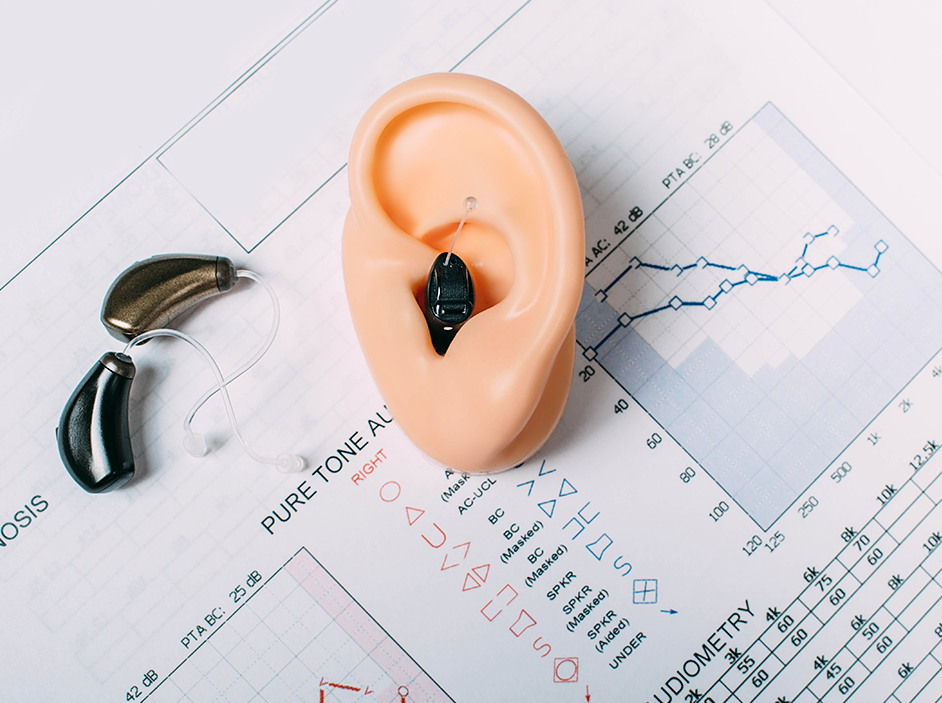
How to Read an Audiogram: An Audiologist’s Step-by-Step Guide

Written by- Dr. S.M. Tarique Najeeb

An audiogram is a graph that shows how well you hear different sounds. During a hearing test, you wear headphones and listen to beeps of different pitches and volumes, raising your hand when you hear them. The test measures sounds from 0 to 120 decibels and frequencies from 250 Hz to 8,000 Hz, which cover most everyday sounds.

Hearing loss affects over 466 million people worldwide, and audiograms help detect it early. Sounds you can’t hear at normal levels indicate the type and severity of hearing loss, helping doctors decide the right care or hearing aids for you.

Audiogram Insights: Know Your Hearing

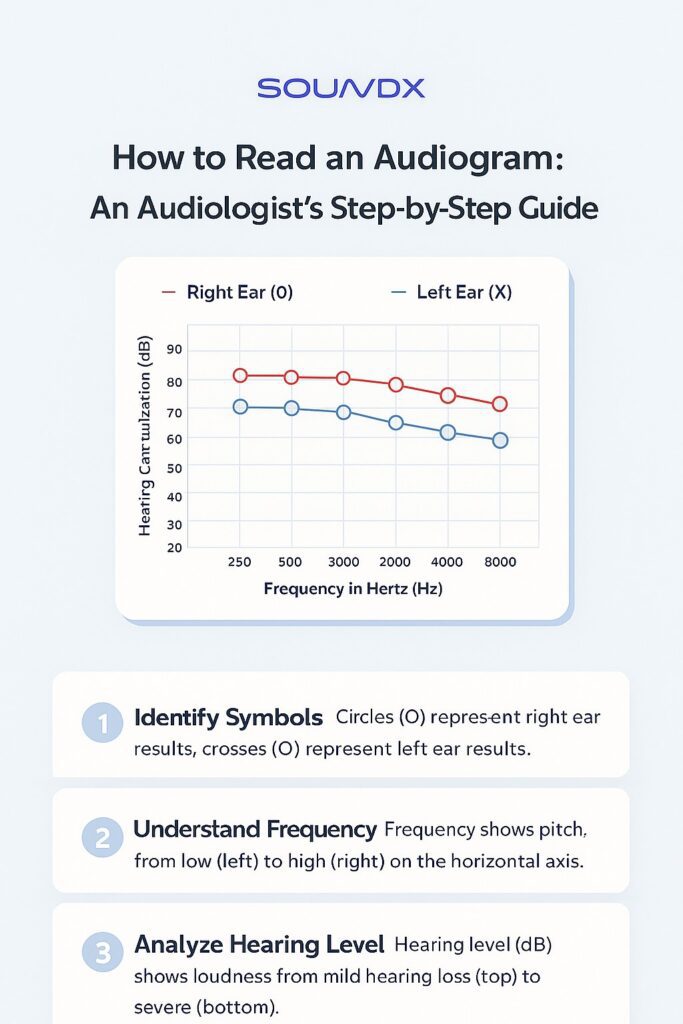
An audiogram is essentially a graph showing a series of O’s (for right ear) and X’s (for left ear). The graph consists of values for different frequencies on the X-axis and volumes on the Y-axis. As you move from left to right on the chart, the frequencies increase from low-pitched to high pitched, while running from top to bottom, the volume of the sound amplifies. The position of O’s and X’s indicate the softest sounds heard by varying the frequencies. This is known as one’s hearing threshold. 

Hearing Loss Levels: Complete Guide

Hearing Loss LevelHearing Threshold (Decibels)What You Can HearWhat’s Difficult to HearTreatment Needed
Normal Hearing-10 to 15 dBAll everyday sounds clearlyNoneNo treatment needed
Slight Hearing Loss20 to 25 dBMost soundsVery soft sounds, whispersMay not need hearing aids
Mild Hearing Loss26 to 40 dBLouder conversationsSoft speech, distant soundsHearing aids recommended
Moderate Hearing Loss40 to 55 dBLoud speech onlyNormal conversations, TV at normal volumeHearing aids necessary
Moderately-Severe Hearing Loss56 to 70 dBVery loud soundsMost speech without amplificationHearing aids required
Severe Hearing Loss71 to 90 dBOnly very loud soundsAlmost all speech and environmental soundsPowerful hearing aids needed
Profound Hearing LossAbove 90 dBAlmost nothingCannot hear speech or most soundsPowerful hearing aids or cochlear implants

How to Read an Audiogram

On an audiogram, you’ll see O’s and X’s. These symbols show how well a person hears different sounds. If the symbol is lower on the chart, it means the person needs louder sounds to hear that frequency—they have more hearing loss at that pitch.

Hearing loss is usually grouped into mild, moderate, severe, and profound. Most people with hearing loss have trouble hearing high-pitched sounds, like birds chirping, women’s voices, or some consonants like F, K, TH, and S. Vowel sounds (A, E, I, O, U) are lower-pitched and easier to hear. People with hearing loss may miss certain consonants, which makes it hard to understand words like cat, show, or throw.

Here are some key measurements from an audiogram:

  • Speech Reception Threshold (SRT): The softest level at which someone can hear and understand speech 50% of the time.
  • Speech Discrimination: How many single-syllable words a person can correctly repeat at a louder volume (usually 30 dB above SRT).
  • Word Recognition Score: The percentage of words a person can recognize at their hearing level.
  • Acoustic Reflex: Checks how the ear muscles react to very loud sounds.
  • Tympanometry: Measures how the eardrum moves with air pressure.
    • Type A: Normal eardrum movement
    • Type B: Limited movement, possible damage
    • Type C: Negative pressure in the ear

These tests help doctors understand which sounds a person can hear and which they have trouble with, so they can decide the best treatment or hearing aids.

Hearing Loss Levels: Mild, Moderate, and Severe Explained

Patients are often curious about the ‘percentage’ of their hearing loss. However, there is no specific formula that can convert the logarithmic dB values to a meaningful hearing loss percentage. Normal hearing range is defined as hearing threshold of -10 to 15 decibels at all frequencies. Given below are the definitions pertaining to various degrees of hearing loss experienced by patients:

  1. Slight Hearing Loss: Hearing threshold in the range of 20 to 25 dB.
  2. Mild Hearing Loss: Hearing threshold in the range of 26 to 40 dB.
  3. Moderate Hearing Loss: Hearing threshold in the range of 40-55 dB.
  4. Moderately-severe Hearing Loss: Hearing threshold in the range of 56-70 dB.
  5. Severe Hearing Loss: Hearing threshold in the range of 71-90 dB.
  6. Profound Hearing Loss: Hearing threshold above 90 dB.

Before coming to any conclusion, it is important to visit a local audiologist like SoundX for a thorough hearing examination

About Online Hearing Tests

The internet is replete with free online hearing tests which promise to provide a thorough examination of one’s hearing abilities. However, they can only help you gauge slightly into your hearing health, and are not a substitute of professional hearing tests run by audiologists or hearing care specialists. In order to get your condition diagnosed and treated properly, you need to see a professional who would not only run detailed hearing tests, but also perform a physical assessment of the ear canal. In some cases, hearing loss is reversible, and can be cured easily, like in the case of excessive build-up of earwax. The earwax might be the only reason for the inaccurate results you might obtain from an online hearing evaluation. Therefore, before coming to any conclusion, it is important that you visit a local audiologist and request for a thorough hearing examination. 

Bottom Line: Audiogram Insights

An audiogram is a very useful tool to check how well you hear. It’s a graph that shows the softest sounds you can hear at different pitches.

  • If the O’s and X’s are near the top of the chart, your hearing is likely fine.
  • If the symbols are lower, it could mean hearing loss.

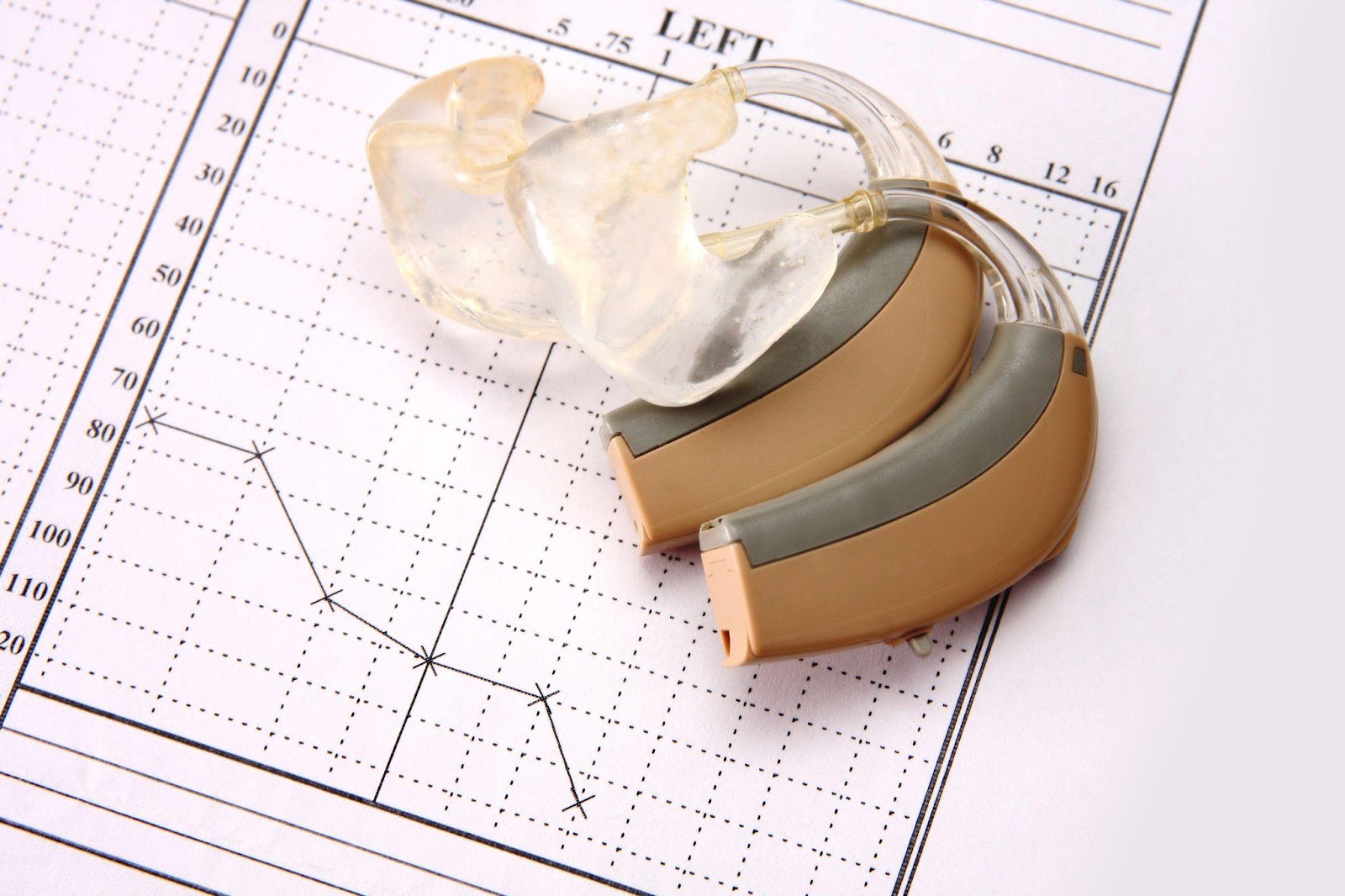
Audiograms help your doctor understand the type and level of hearing loss. This way, they can suggest the right treatment, like a hearing aid. Many experts recommend custom hearing aids after looking at your audiogram so it fits your needs perfectly. The type of hearing aid may also depend on your lifestyle—whether you stay mostly indoors or spend time in noisy places.

Hearing loss can make everyday life harder, but a hearing aid can help make sounds louder and clearer. Remember, hearing aids cannot completely fix hearing loss, but they can help you hear better every day. With patience and regular use, your hearing can improve, making life easier and more enjoyable.

The type of hearing aid may also depend on your lifestyle—whether you stay mostly indoors or use travel-ready hearing aids in noisy places

If you live in or around Kanpur and want a professional hearing evaluation, you can visit SoundX Kanpur.Their certified audiologists use modern equipment to ensure every test is accurate and comfortable

FAQ

1. What is an audiogram?
An audiogram is a graph that shows how well you hear different sounds at different pitches and volumes.

2. What do the O’s and X’s on an audiogram mean?
O’s are for the right ear and X’s are for the left ear. Their position shows the softest sounds you can hear.

3. What do the top and bottom positions on an audiogram mean?
Symbols at the top mean your hearing is normal. Symbols lower down mean you need louder sounds to hear, which shows hearing loss.

4. What are the types of hearing loss?
Hearing loss can be slight, mild, moderate, moderately-severe, severe, or profound, depending on how soft a sound you can hear.

5. Can audiograms tell how bad my hearing loss is?
Yes! They show which sounds you can and cannot hear, helping doctors decide the right treatment.

6. What tests are part of an audiogram?
Some tests include Speech Reception Threshold, Speech Discrimination, Word Recognition, Acoustic Reflex, and Tympanometry.

7. Can online hearing tests replace a real audiogram?
No. Online tests can only give an idea of your hearing. A professional audiologist is needed for a proper test and treatment.

8. Can hearing aids fix hearing loss completely?
No. Hearing aids make sounds louder and clearer but cannot fully restore hearing. They help you hear better every day

Dr S.M. Tarique Audiologist says:

Don’t fall for the myths! Stay tuned to learn everything about ear care and protect your hearing health.

Visit Profile- Dr. S.M. Tarique Najeeb
How Hearing Aid Technology Has Changed Over the Years

Written by- Dr. S.M. Tarique Najeeb

Medical Disclaimer:

This content is for educational purposes only and does not replace professional medical advice. Always consult a qualified audiologist before choosing a hearing aid.

Hearing loss affects over 430 million people worldwide, according to the World Health Organization (WHO). To help them hear better, hearing aid technology has improved dramatically over time.

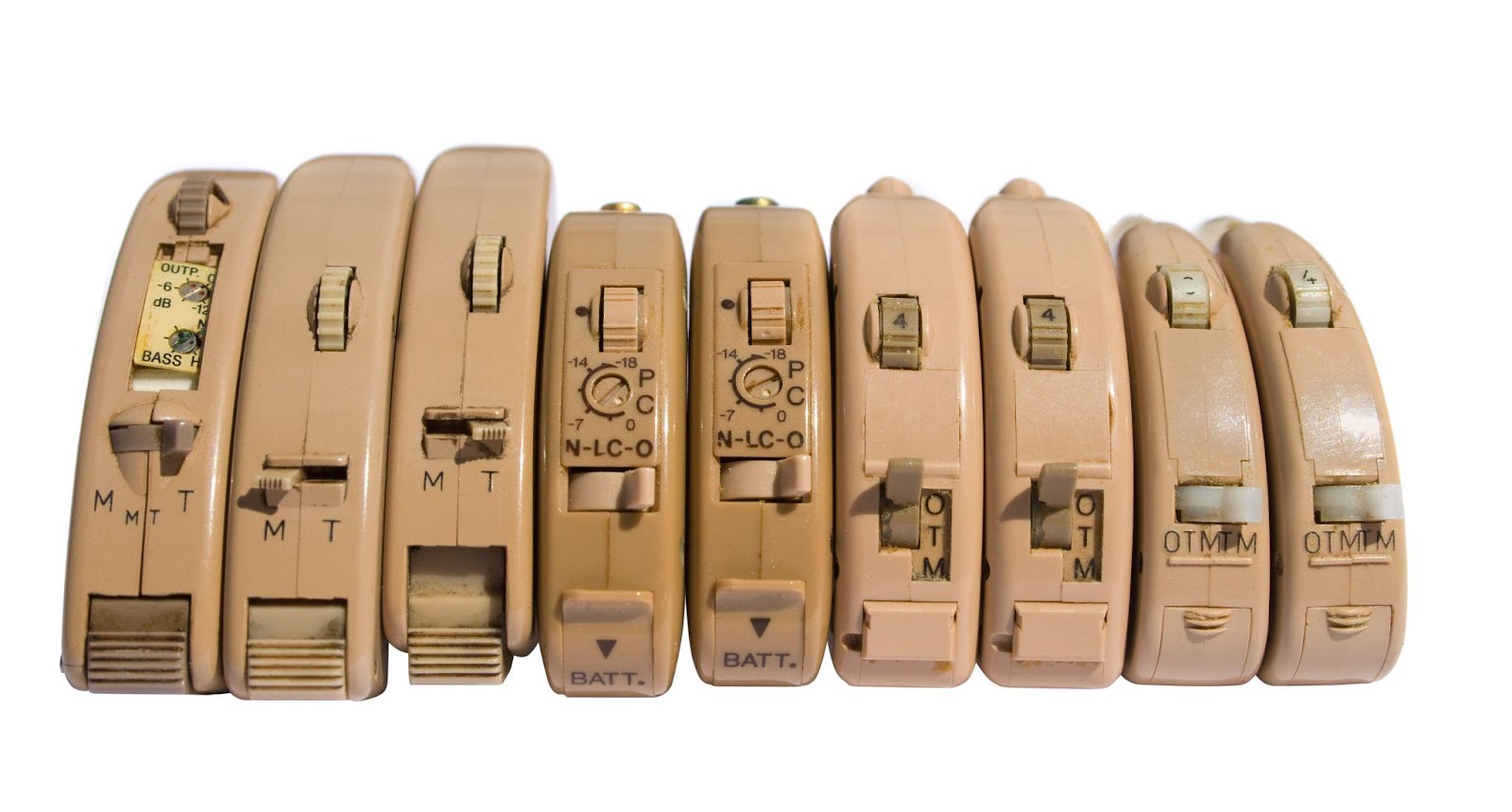
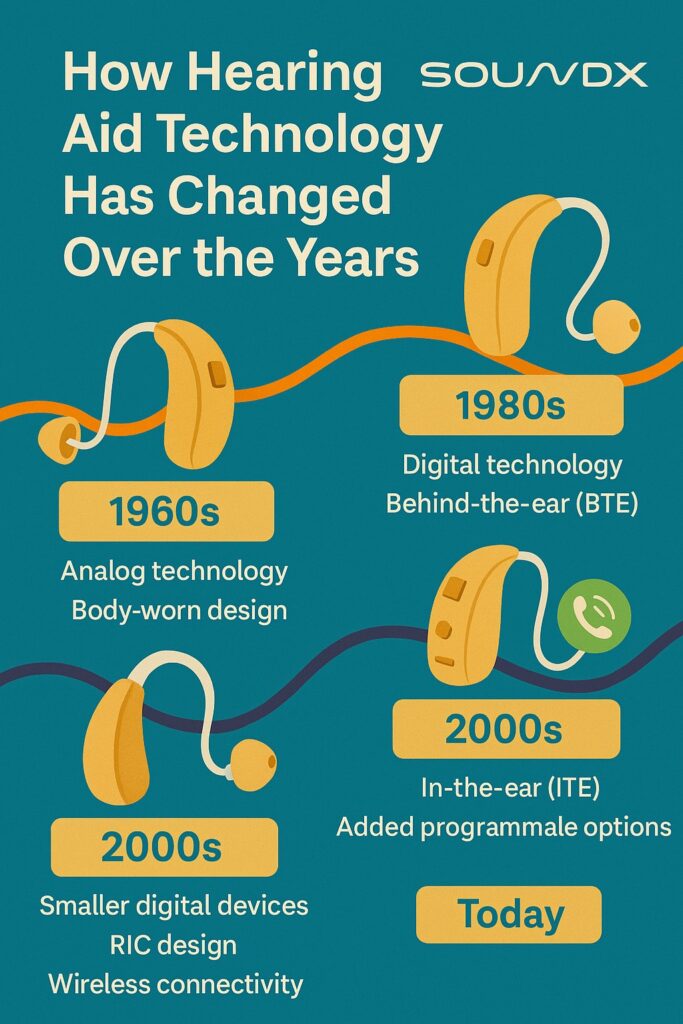
Centuries ago, people used animal horns and ear trumpets to collect sound. In the 1900s, the first electric hearing aids were introduced — large, heavy, and difficult to carry.Today’s digital hearing aids are tiny, powerful, and smart. They reduce background noise, connect to smartphones via Bluetooth, and automatically adjust to different environments. From simple horns to high-tech devices, hearing aids now help millions live, listen, and communicate with confidence.

“At our recent hospital event, SoundX took hearing health awareness to new heights — empowering more people to listen, care, and act for better hearing.”

Let’s have a look at the history of hearing aids: 

When was the first hearing aid invented?

The first hearing device ever recorded was called an ear trumpet, made in the 17th century. It looked like a small horn and was made from things like metal or animal horns. People held it up to their ear to make sounds louder during conversations.

But this early invention had some problems. The ear trumpet was heavy and had to be held by hand all the time. It only worked when someone knew you were talking to them — otherwise, they couldn’t hear you at all!

The first real hearing aid, the kind that actually used electricity, came much later in 1898. It was created by Miller Reese Hutchison, who was inspired by Alexander Graham Bell’s telephone. His invention could amplify weak sounds, making it much easier for people with hearing loss to hear clearly.

From simple horns to electric hearing aids, this was the start of the amazing hearing aid technology we use today — helping millions of people around the world hear better every day.

How Hearing Aids Got Smarter Through the Years

After the first hearing aids were designed, it took about 10 more years before they were made for home use. This happened in 1913, but these early devices were only a little better than the old ear trumpets—still heavy and not very easy to carry.

In the 1920s, Earl C. Hanson invented the vacuum tube hearing aid, called the “Vacuphone”, which turned sounds into electrical signals before sending them to the ear. It worked better than anything before and was later produced by Western Electric Company.

During World War II, engineers started trying to make devices smaller and more efficient. This led to the creation of the transistor in 1948, which replaced vacuum tubes in hearing aids. Transistor hearing aids were smaller, used less battery power, and sounded clearer. The first transistor hearing aid, called the Solo-Pak, was made by Allen-Howe Electronics Corporation.

In the 1970s and 1980s, technology continued to improve:

·         Cochlear implants were developed and tested.

·         Microprocessor hearing aids were introduced, making devices smarter and able to adjust sounds automatically.

Finally, in 1991, the first all-digital hearing aid was created. Since then, hearing aids have continued to improve, becoming smaller, smarter, and more effective at helping millions of people hear clearly and enjoy life.

Since then, the world has watched these digital hearing aids develop past what the hearing impaired ever thought possible. Over the next 20 years, these aids would gain convenience features such as volume controls, static filtered, next-to-zero distortion rates, and even Bluetooth capabilities. 

Today, more companies than ever are involved in the field of Audiology. Hearing aids that are waterproof, shockproof, and dustproof are essentially normal. There even exists an app that transforms the iPhone into an interactive hearing device that amplifies sound and repeats back conversations.  

How Modern Hearing Aids Are Different From Old Hearing Aids

Add simple bullet comparison:

  • Size
  • Sound quality
  • Noise handling
  • Connectivity
  • Comfort

This improves:

  • Featured snippet eligibility
  • Time on page
  • User satisfaction

Evolution of Hearing Aid Technology – Historical Comparison

Time PeriodDevice TypeKey FeaturesSize & PortabilityPower SourceSound QualityLimitationsNotable Innovation
17th CenturyEar TrumpetSimple sound amplification, horn-shaped device, made from metal or animal hornsLarge, handheld deviceNone (passive acoustic)Basic sound collection onlyHeavy, required manual holding, only worked in direct conversation, no amplification controlFirst recorded hearing assistance device
1898Electric Hearing AidUsed electricity to amplify sounds, inspired by telephone technologyLarge and bulkyElectric powerAmplified weak sounds clearlyNot portable, difficult to useFirst electrically powered hearing aid by Miller Reese Hutchison
1913Early Home Use ModelsSlightly improved portability for home environmentsStill heavy and cumbersomeElectricMarginally better than ear trumpetsLimited improvement over previous modelsFirst hearing aids designed for home use
1920sVacuum Tube Hearing Aid (Vacuphone)Converted sounds into electrical signals before transmitting to earModerate sizeVacuum tubesBetter sound conversion and clarityRequired vacuum tubes, moderate power consumptionInvented by Earl C. Hanson, produced by Western Electric Company
1948Transistor Hearing Aid (Solo-Pak)Replaced vacuum tubes with transistors, more efficient signal processingSignificantly smallerBattery-powered (low consumption)Clearer sound qualityStill visible, limited featuresFirst transistor hearing aid by Allen-Howe Electronics Corporation
1970s-1980sMicroprocessor Hearing Aids & Early Cochlear ImplantsAutomatic sound adjustment, smart processing capabilities, cochlear implant testingSmaller, more discreetLow-power batteriesEnhanced clarity with automatic adjustmentsLimited digital featuresIntroduction of microprocessors and cochlear implant development
1991First All-Digital Hearing AidComplete digital signal processing, programmable settingsCompact designEfficient battery useSuperior digital sound qualityEarly stage of digital technologyRevolutionary transition from analog to digital
2000s-2010sAdvanced Digital Hearing AidsVolume controls, static filtering, near-zero distortion, Bluetooth connectivityVery small, discreetLong-lasting batteriesHigh-fidelity sound, wireless streamingRequires charging or battery replacementBluetooth integration and smartphone compatibility
Present Day (2020s+)Smart Digital Hearing AidsWaterproof, shockproof, dustproof, smartphone app integration, automatic environment adaptation, background noise reduction, iPhone amplification appsTiny, nearly invisible, comfortable fitRechargeable batteriesExceptional clarity, AI-powered adjustmentsCost can be prohibitive for some usersMultiple manufacturers, app-controlled devices, virtually invisible implants

What Is the Future of Hearing Aid Technology?

Mention:

  • AI-based sound processing
  • Health tracking
  • Brain-hearing integration
  • Smarter apps

Conclusion

Over the years, hearing aids have changed a lot. They went from big, heavy devices to tiny, nearly invisible implants that fit comfortably in the ear. Because of this, millions of people with hearing loss can live normal, active lives.

What the future holds for hearing aids is still a mystery, but one thing is clear: hearing aids have a long history of progress and will continue to improve for many years to come.

If you or someone you know has trouble hearing, SoundX can help. They have modern hearing aids that are comfortable, easy to use, and make sounds clear again. Visit SoundX Gurgaon today to find the best hearing aid for you and enjoy the world of sound!

FAQ

1. What is a hearing aid?

A hearing aid is a small device that helps people hear better by making sounds louder and clearer.

2. How many people have hearing loss?

Over 430 million people worldwide have hearing loss, according to the World Health Organization.

3. When was the first hearing aid made?

The first hearing device, called an ear trumpet, was made in the 17th century. The first electric hearing aid was created in 1898.

4. Who invented the first electric hearing aid?

Miller Reese Hutchison invented the first electric hearing aid in 1898, inspired by Alexander Graham Bell’s telephone.

5. How did hearing aids get smaller and smarter?

The invention of the transistor in 1948 made hearing aids smaller, used less battery power, and sounded clearer. Later, microprocessors and digital technology made them even smarter.

6. What can modern hearing aids do?

Today’s hearing aids can reduce background noise, connect to phones via Bluetooth, adjust automatically, and even work underwater or in dusty conditions.

7. What are cochlear implants?

Cochlear implants are special devices that help people with severe hearing loss hear by directly sending sound signals to the inner ear.

8. What does the future of hearing aids look like?

Hearing aids will keep improving, becoming smarter, smaller, and more helpful, possibly with even better apps and advanced technology to make hearing easier.

Dr S.M. Tarique Audiologist says:

You do not suddenly lose hearing, It happens in tiny steps that most people ignore.

Visit Profile- Dr. S.M. Tarique Najeeb
All Hearing Aid Tests You Must Know Before Choosing One

Written by- Dr. S.M. Tarique Najeeb

There are 7 main types of hearing tests that audiologists use, depending on your age and symptoms. These tests help them figure out exactly how well your ears are working and what kind of help you might need. Knowing about these tests beforehand makes the process easier and less scary. By understanding what to expect, you can confidently book your hearing check and take the first step toward better hearing.

Over 1.5 billion people worldwide experience some form of hearing loss, with 430 million of them requiring rehabilitation for disabling hearing loss, World Health Organization. By 2050, it’s projected that over 700 million people will have disabling hearing loss from the World Health Organization. Early detection through hearing tests can help prevent further issues and improve quality of life.

7 Types of Hearing Tests You Need to Know

1) Audiometry:

This test checks how well you hear different sounds, from very low to very high pitches. You wear headphones, and every time you hear a beep, you raise your hand or press a button. The results are shown on a graph called an audiogram, which helps the audiologist see what sounds you can and cannot hear.

2) Speech Testing:

This test checks how well you understand words and speech at different volumes. Sometimes it’s done in a quiet room, and sometimes in a noisy one to mimic real life. The results help the audiologist decide if you need a hearing aid or another device.

3) Tympanometry:

This test looks at how your eardrum moves. It can find fluid, wax buildup, or damage in your middle ear. A small probe goes into your ear, and different sounds and pressures are tested. The results are shown on a graph called a tympanogram.

4) Acoustic Reflex Measures and Static Acoustic Measures:

This test checks how well the muscles in your ear work, especially in children under 5. Loud sounds are played, and the audiologist sees if your ear responds. If the ear needs louder sounds to react, it may show hearing damage.

5) Electrocochleography (ECOG):

ECOG measures how your inner ear (cochlea) reacts to sound. Earphones play sounds, and electrodes on your forehead pick up responses. This test can detect certain conditions like Meniere’s disease.

6) Auditory Brainstem Response (ABR):

This test checks how fast sounds travel from your ear to your brain. It’s often done on babies or young kids. Earphones and small electrodes are placed near the ears and forehead. Sometimes kids need to sleep or get light sedation.

7) Otoacoustic Emissions (OAEs):

OAEs check if your inner ear hair cells are working. A small probe in your ear measures tiny sounds your ear makes when it hears noise. If your ear doesn’t make these sounds, it could mean hearing loss.

Hearing Loss Tests Compared: Find the Right One Fast

Test NameWhat It ChecksHow It WorksBest ForWhat It Detects
AudiometryHow well you hear different sound pitches (low to high)Wear headphones and raise hand or press button when you hear beepsAll agesHearing loss at different frequencies; results shown on audiogram
Speech TestingHow well you understand words and speech at different volumesListen to words in quiet and noisy environmentsPeople with communication difficultiesSpeech comprehension issues; helps decide if hearing aid is needed
TympanometryHow your eardrum movesSmall probe in ear tests eardrum with sounds and pressure changesMiddle ear problemsFluid, earwax buildup, or eardrum damage; results shown on tympanogram
Acoustic Reflex & Static Acoustic MeasuresHow well ear muscles work when exposed to loud soundsLoud sounds played to check if ear muscles respond properlyChildren under 5 years oldHearing damage if ear needs louder sounds to react
Electrocochleography (ECOG)How inner ear (cochlea) reacts to soundEarphones play sounds while electrodes on forehead measure responsesInner ear disordersConditions like Meniere’s disease
Auditory Brainstem Response (ABR)How fast sounds travel from ear to brainEarphones and electrodes placed near ears and forehead; may require sleep or light sedationBabies and young childrenBrain’s response to sound; nerve pathway issues
Otoacoustic Emissions (OAEs)If inner ear hair cells are working properlySmall probe in ear measures tiny sounds your ear makes when hearing noiseNewborn screening and early detectionInner ear damage; no sound emission means possible hearing loss

Final Notes:

Hearing tests are safe and usually need no special preparation. Most people take two or more tests to get an accurate result. After the tests, your audiologist will suggest the best treatment, like therapy, a hearing aid, or sometimes surgery.

If you want a clear and comfortable hearing test experience, visit SoundX. Their experts use modern tools to check your hearing and help you find the right hearing aid for your needs. With SoundX, hearing better becomes simple, easy, and worry-free!

FAQ

1. What is an audiometry test?
Audiometry checks how well you hear different sounds, from low to high. You wear headphones and raise your hand or press a button when you hear beeps.

2. What does a speech test do?
A speech test shows how well you understand words in quiet or noisy places. It helps find speech comprehension problems and if you might need a hearing aid.

3. What is tympanometry for?
Tympanometry checks how your eardrum moves. A small probe in your ear tests for fluid, wax buildup, or eardrum problems.

4. What are acoustic reflex tests?
These tests see if your ear muscles respond correctly to loud sounds. They are usually done for young children under 5.

5. What is Electrocochleography (ECOG)?
ECOG checks how your inner ear (cochlea) reacts to sound. Electrodes on your head measure responses to sounds in your ears.

6. What does an Auditory Brainstem Response (ABR) test show?
ABR shows how fast sound travels from your ear to your brain. It’s mostly for babies and young kids, and sometimes they may need to sleep during the test.

7. What are Otoacoustic Emissions (OAEs)?
OAEs test if your inner ear hair cells are working properly. A small probe in the ear measures tiny sounds your ear makes when hearing noise.

8. Do I need to prepare for a hearing test?
No special preparation is needed. Most people do two or more tests to get accurate results. Your audiologist will then suggest the best treatment.

Dr S.M. Tarique Audiologist says:

Your hearing can reveal what’s happening inside your body. Your ears hear more than sound; they reflect your body’s overall health.

Visit Profile- Dr. S.M. Tarique Najeeb
Make Your New Hearing Aids Comfortable in Just a Few Days

Written by- Dr. S.M. Tarique Najeeb

The fastest way to get used to new hearing aids is to wear them consistently every day, practice listening in different environments, and gradually increase usage while learning the device’s key functions like volume control, noise filtering, and Bluetooth connectivity. It’s also important to give your brain time to adjust to the new sounds and the physical sensation of wearing the device.

Over 430 million people worldwide live with hearing loss, and studies show that consistent hearing aid use can improve communication and quality of life by up to 30%. For those with long-term hearing loss, the brain may need extra time to relearn how to process sound, so starting with short, regular listening sessions and gradually increasing them helps. Following these steps allows users to enjoy clearer sounds, better speech understanding, and a more active lifestyle.

SoundX visited an old age home to bring the gift of hearing to seniors, helping them reconnect with their loved ones and the world around them.”

Practice these techniques to make your hearing aids feel natural quickly:

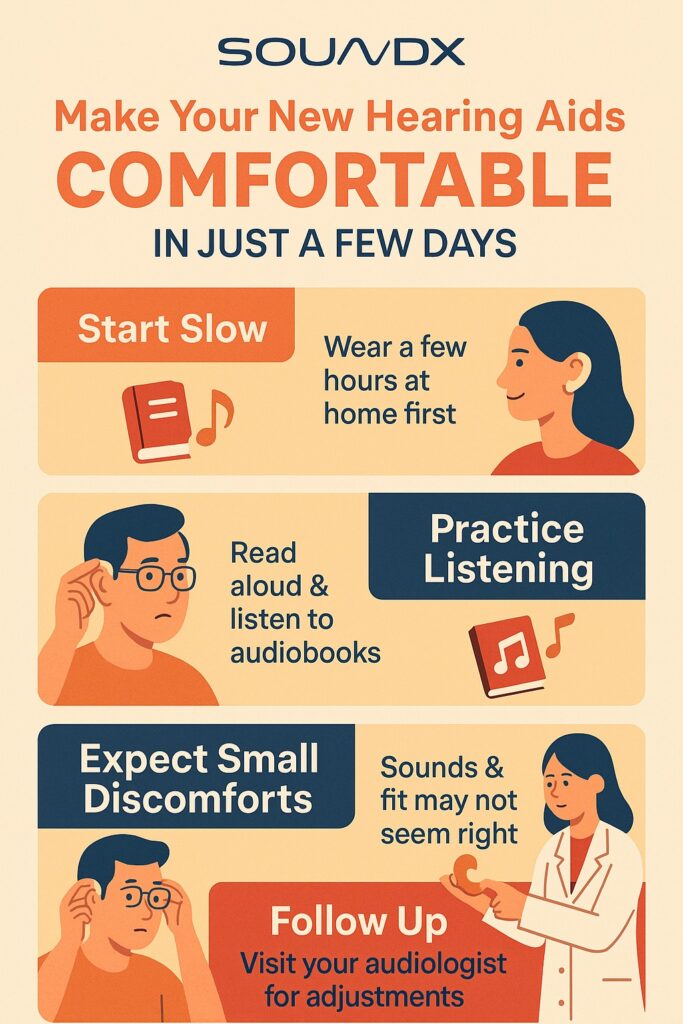
1. Wear Them a Little at First
If this is your first hearing aid, don’t wear it all day right away. Start with a few hours at a time—around 8 hours or less—and slowly increase the time each day. The more you wear it, the better your brain becomes at understanding different sounds. But go slow and give yourself time to adjust.

2. Start in a Quiet Place
For the first few weeks, use your hearing aid in calm, quiet places. This helps your brain recognize sounds better. Once your brain gets used to hearing in quiet places, it will be easier to handle noisy places like restaurants or shopping malls.

3. Practice Listening Exercises
Spend some time each day listening to small sounds around you. Sit in a quiet room and notice things like a bird chirping, a clock ticking, or your own voice. Try reading out loud so your brain can connect words with the sounds you hear. You can also practice figuring out where sounds are coming from.

4. Check In with Your Audiologist
Visit your hearing doctor one or two weeks after getting your hearing aid. They can adjust the device to make sounds clearer, improve the fit, or answer any questions you have. Regular check-ins help you get the best results.

5. Join Hearing Aid Classes
If you can, join online or in-person classes for new hearing aid users. These classes teach useful tips, answer questions, and let you learn from other people who wear hearing aids.

6. Watch TV with Subtitles
If you’ve had hearing loss for a long time, your brain may need practice connecting sounds with words. Turn on subtitles when watching TV or movies. Reading the words while listening helps your brain understand speech more easily.

Achieving Success with Your Hearing Aid

Using a hearing aid successfully takes time, patience, and practice. Here are some important tips to help you get the most out of your device.

1. Be Patient and Stay Positive
It’s normal if your new hearing aid feels strange at first. Don’t get frustrated if you can’t adjust in the first few days. Be patient and keep a positive attitude. The more you focus on improving your hearing, the easier it will become to adapt. If you stick with it through the first few weeks, you’ll see much better long-term results.

2. Have Realistic Expectations
Hearing aids improve your hearing, but they don’t make it perfect. Don’t expect to hear everything clearly right away. Instead, focus on small improvements every day. Celebrate the progress you make, even if it’s just noticing sounds you hadn’t heard before.

3. Learn About Your Hearing
Understanding your hearing loss helps you use your hearing aid better. Read about your condition, learn how hearing aids work, and know what features might help you most. Being informed will make it easier to manage your hearing loss successfully.

4. Practice Every Day
Wear your hearing aid regularly and practice listening exercises daily. Start in quiet places, then move to slightly noisier environments. Over time, your brain will get used to different sounds, and listening will feel automatic. Try to wear your hearing aid during most of your waking hours as you get more comfortable.

Complete Guide to Adjusting to New Hearing Aids

Adjustment MethodTime FrameStarting PointDaily DurationKey ActionsBenefitsSuccess TipsExpected ResultsDifficulty LevelProfessional Support
Gradual Wearing ScheduleFirst 2-4 weeksAny comfortable settingStart 8 hours or less, increase dailyWear device consistently but not all day initially, slowly extend wearing time each dayBrain adapts without overwhelm, builds tolerance naturallyDon’t rush – increase by 1-2 hours every few days, listen to your bodyBetter long-term comfort and sound recognitionEasyMinimal – audiologist guidance helpful
Quiet Environment PracticeFirst 2-3 weeksCalm quiet places like home or libraryMultiple hours daily in peaceful settingsUse device only in quiet spaces before introducing noiseBrain learns to recognize individual sounds clearly firstStay in quiet rooms, avoid restaurants and malls initiallyEasier transition to complex noisy environments laterEasyNone required
Daily Listening ExercisesThroughout adjustment (ongoing)Quiet room at home15-30 minutes per dayFocus on small sounds – birds chirping, clock ticking, your own voiceImproves sound identification and spatial awarenessPractice locating where sounds come from, notice quiet detailsEnhanced ability to identify and locate sound sourcesModerateOptional – classes can help
Read Aloud PracticeFirst 4 weeks dailyAny quiet space10-20 minutes per sessionRead books, articles, or news out loud while wearing deviceConnects words with sounds heard through hearing aidChoose interesting material, speak at normal volumeBetter word-sound association and speech clarityEasyNone required
TV Subtitle TrainingFirst 4-6 weeks (critical for long-term hearing loss)Home entertainment areaDuring all TV and movie viewingAlways turn on subtitles while watching any contentBrain reconnects sounds with visual words, faster comprehensionWatch familiar shows first, read and listen simultaneouslyDramatically improved speech understandingEasyNone required
Audiologist Follow-upsWeek 1-2, then regularly as neededAudiology clinic or office30-60 minutes per appointmentProfessional device adjustments, fit optimization, ask questionsCustomized settings for optimal clarity and comfortBring written list of concerns, be specific about issuesPerfect device tuning and troubleshootingEasyEssential – required
Support Groups and ClassesOngoing throughout processOnline platforms or in-person venues1-2 hours weekly or monthlyJoin hearing aid user communities, attend workshopsLearn from experienced users, get practical tips and emotional supportAsk questions freely, share your experiences with othersFaster problem-solving and reduced frustrationEasyOptional but recommended
Patient Positive MindsetEntire adjustment period (3+ months)Daily mental practiceOngoing every dayStay positive, don’t get frustrated, focus on small improvementsReduces stress, prevents device abandonmentRemind yourself adjustment is normal and takes timeHigher success rate and continued device useModerateOptional counseling if struggling
Realistic Expectations SettingBefore and during adjustmentInitial consultationDaily mindset checkUnderstand hearing aids improve but don’t perfect hearingPrevents disappointment, maintains motivationCelebrate small wins like hearing new soundsSustained long-term satisfaction with deviceEasyAudiologist sets expectations
Educational LearningFirst 2-4 weeks intensivelySelf-study at home2-3 hours initially, ongoingRead about hearing loss, learn device features and functionsEmpowered self-management, better troubleshootingFocus on key features first – volume, programs, cleaningConfident independent device useModerateOptional resources provided
Progressive Environment ExposureWeeks 1-8 gradual progressionQuiet home → moderate → noisy publicIncrease complexity weeklyWeek 1-2 quiet, Week 3-4 moderate noise, Week 5+ restaurants/mallsBuilds real-world confidence in all situationsRetreat to quiet if overwhelmed, use noise filtersComfortable hearing in challenging environmentsModerate to DifficultAudiologist adjustments help
Consistent Daily PracticeMinimum 8-12 weeks for full adjustmentMorning routine integrationGradually increase from 8 to 14-16 hours dailyWear device during all waking hours as comfort increasesCreates automatic listening habits, maximum benefitSet phone reminders, make it part of morning routineDevice becomes second nature, worn without thinkingModerateMinimal after initial setup

Critical Success Factors: Wear consistently every day | Start in quiet environments | Increase time gradually | Practice listening exercises | Schedule audiologist follow-ups within 1-2 weeks | Use subtitles for speech training | Join support communities | Stay patient and positive | Set realistic expectations | Learn device features thoroughly

Timeline Summary: Days 1-7 (device feels strange, 4-8 hours daily) → Weeks 2-3 (getting comfortable, 8-10 hours daily) → Week 4 (feels natural, 10-12 hours daily) → Weeks 5-8 (well-adjusted, 12-16 hours daily) → Month 3+ (fully adapted, automatic use all day)

Remember: Adjusting to a hearing aid takes time, patience, and practice. Don’t hesitate to ask your  hearing care professional for help if you face any issues. Once you get used to your device, it can make a big difference in your daily life, helping you communicate better and enjoy sounds around you.

Final Note:
Getting used to your new hearing aid takes time, but it’s worth it. Be patient, practice every day, and follow your audiologist’s advice. Soon, hearing will feel natural again, and you’ll enjoy every sound around you.

If you need help choosing or adjusting your hearing aid, visit SoundX. They make hearing easy and comfortable with modern hearing aids and caring support.

FAQ

1. How long does it take to get used to hearing aids?
Most people start feeling comfortable with their hearing aids in about 3 to 8 weeks. The more you wear them, the faster your brain adjusts to new sounds.

2. Should I wear my hearing aids all day right away?
No. Start by wearing them for a few hours each day, then slowly increase the time. This helps your ears and brain get used to hearing again.

3. Why should I begin in quiet places?
Quiet places help your brain learn to recognize sounds clearly without too much noise. Once you’re comfortable, you can start using them in louder places.

4. What are listening exercises?
Listening exercises mean practicing small things like hearing birds chirp, a clock tick, or reading out loud. These help your brain understand and locate sounds better.

5. Why should I visit my audiologist after getting hearing aids?
Your audiologist can check if your hearing aids fit well and adjust the settings so you hear more clearly. They can also answer any questions you have.

6. How do subtitles help with hearing?
Watching TV or movies with subtitles helps your brain connect words with sounds again. It makes it easier to understand people when they talk.

7. What if my hearing aids feel uncomfortable?
It’s normal for new hearing aids to feel strange at first. If they hurt or feel too tight, tell your audiologist so they can fix the fit.

8. What’s the most important thing to remember when using hearing aids?
Be patient and positive! Getting used to hearing aids takes time, but if you wear them every day and practice listening, they’ll soon feel natural.

Dr S.M. Tarique Audiologist says:

Hearing loss is easier to fix when you catch it early. Most people wait too long and make it harder to recover clarity.

Visit Profile- Dr. S.M. Tarique Najeeb

What are the different types of hearing aids?

Written by- Dr. S.M. Tarique Najeeb

Medical Disclaimer:

This content is for educational purposes only and does not replace professional medical advice. Always consult a qualified audiologist before choosing a hearing aid.

There are mainly two main types of hearing aids — In-the-Ear (ITE) and Behind-the-Ear (BTE).
These two types come in many small designs to fit different ears and lifestyles.

According to the World Health Organization (WHO), more than 430 million people around the world live with hearing loss. Many of them use hearing aids to hear clearly, enjoy conversations, and live better lives.
Buying a new hearing aid can be confusing because there are so many shapes, sizes, and features. But don’t worry — let’s understand them in a simple way.

In-the-Ear (ITE) Hearing Aids

ITE hearing aids fit inside your ear. They are made just for your ear shape, so they feel comfortable.
All the small parts — like the microphone and speaker — are placed inside a tiny shell that fits in your outer ear.
ITE hearing aids are good for mild to severe hearing loss and may include special features like telecoils (which help you hear better in noisy places) and directional microphones (which focus on sounds coming from in front of you).

Common types of ITE hearing aids include:

  • Invisible-in-Canal (IIC)
  • Completely-in-Canal (CIC)
  • In-the-Canal (ITC)
  • Low-profile models
Type of hearing aids

Now, let’s understand each one simply

1. Invisible-in-Canal (IIC):
IIC hearing aids are the smallest type and fit deep inside the ear canal, making them almost invisible. They are very comfortable and make sounds feel natural, but they need careful cleaning and are best for people with mild to moderate hearing loss and wide ear canals.

2. Completely-in-Canal (CIC):
CIC hearing aids are slightly bigger than IICs and sit a little higher in the ear canal. They are still mostly hidden, easier to handle, and better at reducing wind noise, making them suitable for people who want a small but durable device.

3. In-the-Canal (ITC):
ITC hearing aids sit partly in the ear canal and partly in the outer ear. They are larger, so they can have extra features like longer battery life and directional microphones. They are easier to use than smaller types but might sometimes feel like the ear is slightly plugged.

4. Low-Profile Models:
Low-profile hearing aids are the largest ITE type, filling half or the entire outer ear. They can include many extra features and are very comfortable to wear. The only downside is that they are more visible, but they are easy to handle and adjust, making them ideal for people with moderate to severe hearing loss.

Behind-the-Ear (BTE) Hearing Aids

BTE hearing aids sit behind your ear. A small plastic tube connects the device to an ear mold that fits inside your ear.
They are the most common type and can help with all levels of hearing loss — from mild to severe.

Good things about BTEs:

  • Strong and easy to handle.
  • Long battery life and more features.
  • Great for both children and adults.

Fact: BTE hearing aids are used by nearly 70% of hearing aid users worldwide because they are reliable and fit most people comfortably.

Who Should Choose Which Hearing Aid?

Add 5–6 simple bullets:

  • IIC → people wanting invisible hearing aids
  • CIC → discreet but easier handling
  • ITC → balance of features & size
  • Low-profile ITE → seniors & severe loss
  • BTE → children, elderly, all hearing loss

This boosts:

  • Featured snippet chances
  • Conversion intent
  • Time on page

Types of Hearing Aids – Complete Comparison Guide

Hearing Aid TypeMain CategorySize & VisibilityPlacement LocationBest For (Hearing Loss Level)Key FeaturesAdvantagesDisadvantagesBattery LifeIdeal User ProfileEase of HandlingSpecial Requirements
Invisible-in-Canal (IIC)In-the-Ear (ITE)Smallest – Almost completely invisibleDeep inside ear canalMild to moderate hearing lossCustom-fitted shell, natural sound quality, discreet designNearly invisible, very comfortable, natural sound feel, cosmetically appealingRequires careful cleaning, needs wide ear canals, limited features, can be difficult to handleShort (small batteries)People wanting maximum discretion with mild hearing loss and wide ear canalsDifficult – small size makes insertion/removal challengingWide ear canals required, regular professional cleaning needed
Completely-in-Canal (CIC)In-the-Ear (ITE)Very small – Mostly hiddenSits higher in ear canal than IICMild to moderate hearing lossCustom-molded, better wind noise reduction, slightly larger than IICMostly hidden, easier to handle than IIC, good wind noise reduction, durableStill small and requires care, limited battery capacity, fewer features than larger modelsShort to moderateActive individuals who want discreet devices but need easier handling than IICModerate – slightly easier than IIC but still requires dexterityManual dexterity needed, regular cleaning required
In-the-Canal (ITC)In-the-Ear (ITE)Medium – Partly visiblePartly in ear canal, partly in outer earMild to moderate hearing lossDirectional microphones, longer battery life, more features than smaller ITEsEasier to use and handle, better features, longer battery, good balance of size and functionPartially visible, may cause plugged ear sensationModeratePeople who want balance between discretion and functionalityEasy – larger size aids handlingNone specific, suitable for most users
Low-Profile (Full Shell/Half Shell)In-the-Ear (ITE)Largest ITE – Most visibleFills half or entire outer ear bowlModerate to severe hearing lossMaximum features (telecoils, volume controls, Bluetooth), very comfortable, powerful amplificationMany advanced features, very comfortable, easy to handle and adjust, powerful soundMost visible ITE type, larger physical presenceLong (larger batteries)People with moderate to severe hearing loss who prioritize features and ease of use over discretionVery easy – large enough for easy manipulationNone – most accessible ITE option
Behind-the-Ear (BTE)Behind-the-Ear (BTE)Visible – Sits behind earBehind ear with tube connecting to ear mold inside earMild to severe hearing loss (all levels)Robust construction, maximum features, long battery life, directional microphones, telecoils, BluetoothStrong and durable, easy to handle, longest battery life, most features available, suitable for children and adults, fits most ear shapesVisible design, tube may be noticeable, can interfere with glassesVery long (largest batteries)Anyone with any level of hearing loss, especially children, elderly, or those needing maximum features and durabilityVery easy – largest size makes all adjustments simpleEar mold fitting required, may need adjustments with glasses

Global Impact: Over 430 million people worldwide live with hearing loss (WHO). Nearly 70% of hearing aid users choose BTE models due to reliability and comfort.

Professional Recommendation: Consult hearing care professionals for hearing tests and personalized fitting to ensure optimal comfort and performance for your specific needs and lifestyle.

Why the Right Fit Matters

When choosing a hearing aid, it’s not just about how bad your hearing is. You also need to think about your lifestyle. For example, do you play sports or spend most of your time indoors? Do you want your hearing aid to be hidden, or is it okay if people can see it?

Knowing the good and bad points of each type of hearing aid can help you pick the one that works best for you. A hearing expert can guide you, but it’s helpful to know all the options before making a choice.

If you are looking for professional hearing aid consultation and fitting, you can visit SoundX Lucknow

Final Thoughts

Whether you are using a hearing aid for the first time or replacing an old one, knowing about different types helps you choose wisely.
If you’re still unsure, visit SoundX Hearing Solutions. Their professionals can test your hearing and help you pick a hearing aid that fits your ear perfectly and makes your daily life easier.

FAQ

1. What is a hearing aid?
A hearing aid is a small device that makes sounds louder so people with hearing loss can hear better. It helps you understand conversations and enjoy everyday sounds.

2. What are the main types of hearing aids?
The two main types are In-the-Ear (ITE) and Behind-the-Ear (BTE). Each type comes in different sizes and styles to fit different ears and lifestyles.

3. Who can use ITE hearing aids?
ITE hearing aids fit inside the ear and are suitable for people with mild to severe hearing loss. They are comfortable, custom-made, and mostly hidden from view.

4. What is the smallest hearing aid?
Invisible-in-Canal (IIC) hearing aids are the tiniest and almost invisible. They fit deep in the ear canal and feel natural, but need careful cleaning.

5. Why are BTE hearing aids so popular?
BTE hearing aids sit behind the ear and are easy to handle. They work for all levels of hearing loss and have long battery life with many features.

6. Can children use hearing aids?
Yes, children can use both ITE and BTE hearing aids. Professionals adjust them to fit tiny ears safely and comfortably.

7. How do I know which hearing aid is right for me?
It depends on your hearing loss, ear shape, and lifestyle. A hearing expert can test your ears and help you choose the best one.

8. Do I need to clean my hearing aids?
Yes, cleaning your hearing aids regularly keeps them working well. Proper care also prevents damage from earwax or moisture.

Dr S.M. Tarique Audiologist says:

Step away from the cotton buds! Most ear-cleaning mistakes do more harm than good.

Visit Profile- Dr. S.M. Tarique Najeeb

How to Wear and Use SoundX Hearing Aids for Clearer Hearing

Written by- Mr Shivam Singh

This guide will help you learn how to set up, use, and take care of your SoundX hearing aids. It will show you easy steps so you can hear better and keep your hearing aids working well every day.

“SoundX proudly participates in ISHACON 2025, Patna, Bihar — one of India’s largest and most respected audiology conferences!”

What Are the Main Parts of SoundX Hearing Aids and How They Work?

  1. Microphone: The microphone on your hearing aids captures sound from your environment, allowing you to hear conversations, music, and other sounds with clarity.
  2. Multi-function Button 1: This button serves multiple purposes. You can adjust the volume of your hearing aids using Button 1. Additionally, pressing and holding Button 1 for a few seconds turns the hearing aids on or off.
  3. Multi-function Button 2: Button 2 also offers versatility. It allows you to decrease the volume of your hearing aids and switch between different hearing programs. Press and hold Button 2 to activate these functions.
  4. Ear Tube: The ear tube is a crucial component that connects the eartip to the main body of the hearing aid. It ensures a secure and comfortable fit within your ear canal.
  5. Stabilization Bar: To prevent the eartip from moving out of place, the stabilization bar provides stability and comfort throughout the day.
  6. Eartip: Made of soft silicone, the eartip holds the hearing aid securely in your ear canal. It’s essential for comfort and proper functionality. It is available in multiple sizes and can be replaced depending on the size of your ear canal. It is also available in perforated and closed styles, which can be used as per the recommendation of your SoundX audiologist.
  7. Charging Contact: These contacts allow for easy charging of your hearing aids. Simply place them in the charging case, and they’ll begin charging automatically.
  8. Charging Case: A portable charging case included for convenient recharge-ability of your hearing aids on the go. One full charge will provide up to 18 hours of enhanced hearing.

Charging Case

Your charging case is an essential accessory for storing and charging your hearing aids:

  1. Charging Slots: The charging case features dedicated slots for each hearing aid, ensuring they receive the power they need to function optimally.
  2. Indicator Lights: LED lights on the charging case provide visual feedback on the charging status of your hearing aids and the case itself. This allows you to monitor the charging progress conveniently.
  3. Charging Port: Connect the charging case to a power source using the included USB cable. This ensures that your hearing aids are always ready for use whenever you need them.

Accessories

The product comes with the below listed accessories.

ItemsDescription
Eartip × 10To hold the hearing aid comfortably and securely in the ear canal
USB Cable x 1Used to charge the charging case
Cleaning Tool × 1Used to clean hearing aids and charging case
Manual x 1Used for users to read and understand how to use hearing aids and other objects

Using Your SoundX Hearing Aids: Simple Steps to Get Started

Fitting Eartips

  1. Selecting Eartips: Choose the eartip size that provides the most comfortable and secure fit for your ears. It’s essential to experiment with different sizes to find the perfect fit.
  2. Attaching Eartips: Once you’ve selected the appropriate eartip size, attach it securely to the ear tube. Ensure that the eartip is pushed firmly onto the ear tube to prevent it from coming loose.

Ear Tube Replacement

  1. Removing Ear Tubes: To replace the ear tubes, gently rotate them and pull them out of the hearing aids. Take care not to apply too much force to avoid damaging the devices.
  2. Inserting New Ear Tubes: When inserting new ear tubes, align them with the corresponding slots on the hearing aids and gently push them into place until they’re securely seated.

Power On/Off

  • Turning On: To power on your hearing aids, press and hold Button 1 for approximately three seconds. You’ll hear a notification sound indicating that the devices are now powered on and ready to use.
  • Turning Off: Similarly, to power off your hearing aids, press and hold Button 2 for about three seconds. You’ll hear a notification sound confirming that the devices have been powered off.

Wearing/Removing Hearing Aids

  • Wearing Hearing Aids: Insert the hearing aids gently into your ear canal, ensuring that the eartips are securely seated. Once in place, the devices should feel comfortable and snug.
  • Removing Hearing Aids: To remove the hearing aids, gently pull them out of your ear canal while holding onto the stabilization bar. Take care not to apply excessive force to avoid discomfort.

Volume Control

  • Adjust the volume of your hearing aids using the multi-function buttons. Each press of Button 1 or Button 2 will increase or decrease the volume, respectively.
  • You’ll hear a “Beep” sound each time you adjust the volume, allowing you to gauge the changes in volume levels.

Programs Switching

  • Your hearing aids come with multiple preset programs designed to enhance your listening experience in different environments.
  • If you want to understand your hearing profile better before programming your hearing aids, you can take a hearing test and learn how to read an audiogram.

Specific programs are associated with different prompt tones as mentioned in the table below:

Hearing ProgramPrompt Tone
1Program 1beep
2Program 2beep beep
3Program 3beep beep beep
4Program 4beep beep beep beep

Bluetooth Connectivity

  • Bluetooth technology allows you to connect your hearing aids to compatible devices such as smartphones, tablets, and computers.
  • To initiate a Bluetooth connection, ensure that Bluetooth is enabled on your device and follow the pairing instructions provided in your device’s user manual.

SoundX App

  • The SoundX app provides additional functionality and customization options for your hearing aids. Download the app to your smartphone and follow the on-screen instructions to set up your devices.
  • With the SoundX app, you can:
    • Adjust volume levels
    • Switch between hearing programs to suit your environment
    • Explore our best hearing aids to choose one that fits your lifestyle
    • Learn about hearing loss via blogs and educational videos
    • Contact SoundX expert audiologists
    • Take a hearing test and program your hearing aids according to your hearing loss profile

Charging Your Devices

Charging Hearing Aids

  1. Placing in Charging Case: When it’s time to charge your hearing aids, simply place them in the designated slots within the charging case. Ensure that they’re properly aligned to facilitate charging.
  2. Monitoring Charging Status: LED indicator lights on the charging case will illuminate to indicate that the devices are charging. A blue light indicates that charging is in progress, while a white light indicates that the devices are fully charged.

Charging the Charging Case

  1. Connecting USB Cable: Use the included USB cable to connect the charging port of the case to a power source, such as a computer or wall adapter.
  2. Monitoring Battery Capacity: LED lights on the charging case will provide real-time feedback on the remaining battery capacity, allowing you to plan your charging schedule accordingly.

Device Care Tips

  • Handle your hearing aids with care to avoid drops or impacts that could damage the devices.
  • Refrain from using sharp objects to clean earwax, as this could cause damage to the eartips and ear tubes.
  • Store your hearing aids in a cool, dry place away from moisture and extreme temperatures to prevent damage.
  • Remove your hearing aids before swimming, showering, or engaging in activities that expose them to water.
  • Regularly inspect and clean your devices to remove debris and maintain optimal performance.
  • Replace eartips every few months to ensure a secure and comfortable fit, and consider replacing ear tubes if they show signs of wear or damage.

This comprehensive user manual provides detailed instructions on using and caring for your SoundX hearing aids. If you have any questions or encounter any issues, don’t hesitate to consult this guide for assistance.

FAQ

1. How do I turn my SoundX hearing aids on and off?
To turn them on, press and hold Button 1 for about 3 seconds until you hear a sound. To turn them off, press and hold Button 2 for 3 seconds.

2. How long do my SoundX hearing aids last after a full charge?
When fully charged, your hearing aids can work for up to 18 hours. Always charge them overnight or when the battery gets low.

3. How do I charge my SoundX hearing aids?
Place them in the charging case. The blue light means they’re charging, and the white light means they’re fully charged.

4. Can I connect my SoundX hearing aids to my phone?
Yes! Your hearing aids have Bluetooth. Just turn on Bluetooth on your phone and follow the pairing steps shown on your phone’s screen.

5. What is the SoundX app for?
The SoundX app helps you control your hearing aids easily. You can adjust the volume, switch programs, take hearing tests, and even talk to an audiologist through the app.

6. How do I clean my hearing aids?
Use the cleaning tool that comes in the box. Gently remove dirt or earwax. Don’t use sharp objects or water to clean them.

7. How do I know which eartip size is right for me?
Try a few sizes to see which one feels most comfortable and fits securely. Your SoundX audiologist can also help you choose the right size.

8. What should I do if my hearing aids stop working?
First, check if they are charged and turned on. If they still don’t work, make sure there’s no dirt blocking the eartip. If the problem continues, contact SoundX support for help.

Mr Shivam Singh Audiologist says:

Not all hearing loss needs surgery . In fact most cases can be managed with modern hearing aids. But in some structural or medical cases, surgery can help.